Sunday, June 18, 2006

Neighbors.


June 18, Rancho Cordova.

Turns out I was neighbor to an oasis of a river, a 20-acre farm and a newfound friend and I didn't even know about it.
Late on Wednesday night when we pulled into the soccer field in Hagan Park, Dawn, her daughter Renna and her boyfriend, Matt, were getting ready to go to bed. Matt called out to Dawn that there was a semi tractor-trailer in the field. Whatever, said Dawn, thinking he'd probably not seen right. Shortly thereafter he called out again. There's a guy out walking and waving a flashlight, he must be drunk or something, he said.
Dawn told me the story when she came to visit us in the trailer on Friday afternoon. They'd discovered upon waking up the next morning there was a circus in their front yard, she'd gone and seen the show and looked up the website afterwards, ultimately stumbling upon the blog. Can I come visit?, she asked, we're going to be neighbors for three days.
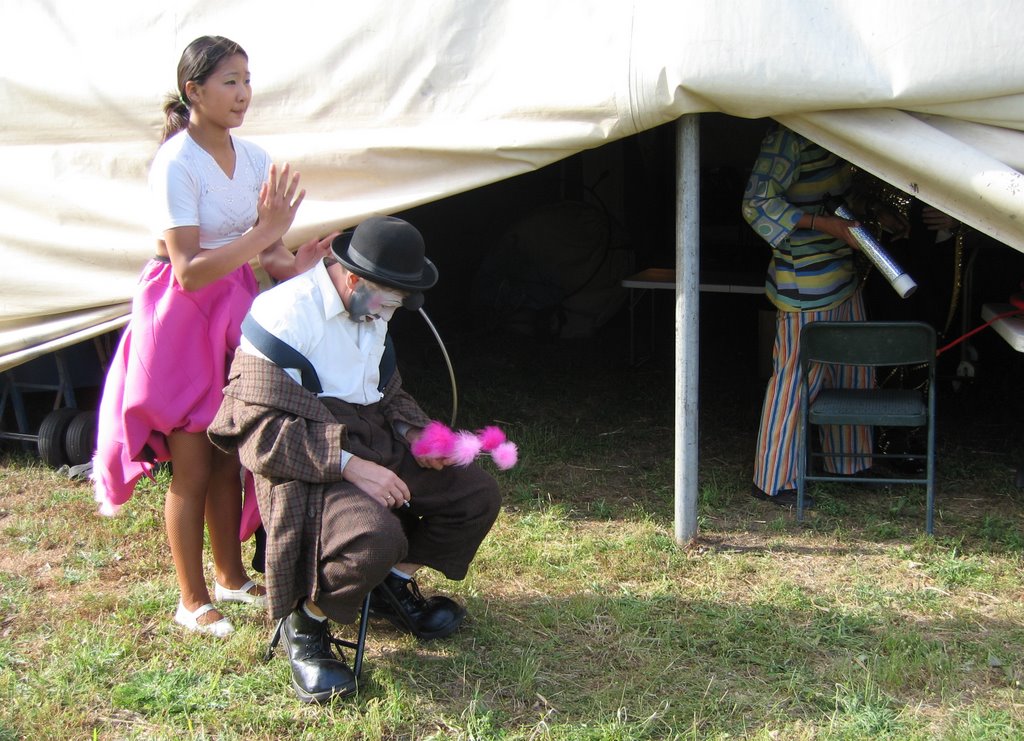
Dawn has raised an adult son and is now raising her daughter, mostly by herself. Renna, who is thirteen, is a poised, shy girl who surprises you when she suddenly sparks to show you her artwork. Mother and daughter share a peaceful nonchalance.
Dawn was always fascinated by the circus, I with the farm. She took me to the river, the American river. It flowed just a few hundred yards behind the circus, the water wonderfully cold, straight from the Sierra snows, the currents so swift. She took me to the farm, a co-op owned and leased by the county of Sacramento. Ten people live on it, renting houses, raising chicken and sheep. The land was bought by the county some 20 years ago and is now an oasis of green amidst the infringing suburbs. She gave me a tour, introduced me around, held Dylan while I used her wireless connection. She sent me home with fresh eggs and grapefruits from the farm, fell in love with Dylan. She and Matt even took me to the farmer's market in downtown Sacramento and came to see the show a second time on Sunday.
Turns out I had a friend in Sacramento. She's living out one of my other dream life, waking up to the roosters every morning, looking out to the fields, walking to the river for a swim. Circus life: a day on the farm, thanks to my newfound neighbors.

Dawn and her daughter, Renna, 13, in front of some of Renna's paintings, in their livingroom.

Adios.

June 16, Rancho Cordova.

Marvin's turn to go.
He was the midget clown from Mexico, the second clown after Genia.This morning as we were leaving on errands we saw him talking on the phone by the office and by the time we came back a couple of hours later we learnt that he was gone from the circus, apparently over an argument with Jim. I'm not sad to see him go; his acts as bad as they come, the scratching my ass and crotch type of low-flying humor, bringing down the quality of the show quite a notch. Adios and good luck.

Thursday, June 15, 2006

The Democratic Idea.

June 15, Rancho Cordova, California.

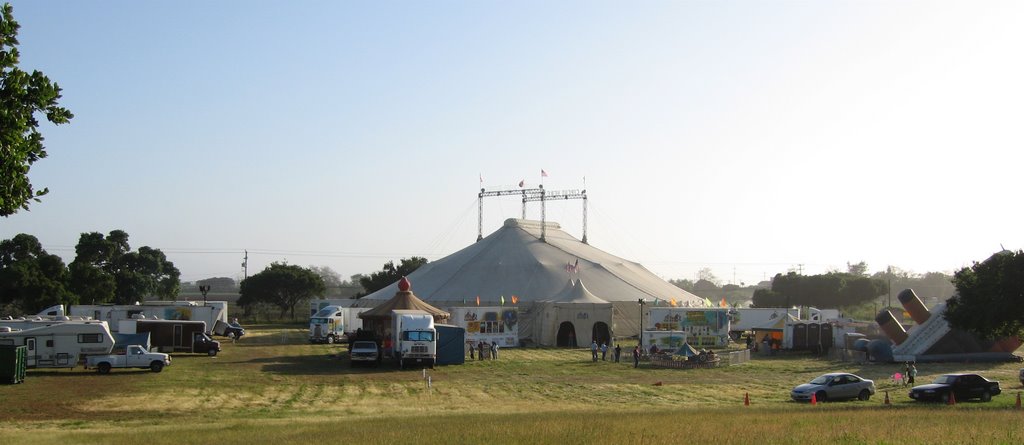
The circus is parked in Hagan Park, in Rancho Cordova, a suburb of Sacramento.
Beautiful public park, vast expanse of shaded, well-tended lawns, oaks, pines, magnolias, ponds and paths, baseball field after baseball field, stretching as far as the eye can see. The idea that you need to set aside land for public use, as strong today in the expanding suburbs as it was in 1858 when Frederick Law Olmsted and Calvert Vaux designed that quintessential public park, Central Park, in New York City, the civic idea, the idea of the American democracy, unique in history, passionately alive despite or because of the other side of the American coin, the greed, the reign of money gone crazy, the Enrons, the widening gap between the rich and the poor.
The public park, or the embodiment of the American faith in the fundamental goodness of its democratic experiment. My own love affair with America and the American idea, the ongoing fascination, after all these years, in spite of everything, still.

Wednesday, June 14, 2006

Payback.

June 14, Lodi.

Dylan turns seven months today, and has turned impossible lately. The last two nights he has screamed his head off at bed time for no apparent reason, and no calming technique will work. It is as if my worst fears about screaming babies had come to bear, those old nightmares from when I didn't want to even hear the word baby; me, I'll never have kids, thanks and don't bother to ask again, and it makes me feel not only inadequate but also unworthy as he struggles and pushes me away no matter what I do.
Welcome to the club - like a faint echo.

Giants.

June 13, Lodi, California.

Went to Wal-mart to look for the last supplies needed to put the finishing touches on the custom-made crib (inauguration was last Saturday, no wood splitting, baby survived,) the "small" version, as usual in California, where the first giant so-called Wal-mart supercenter only opened a couple of years ago. I remember covering it for the Press-Enterprise; the first giant store allowed to open in the state was in La Quinta, near Palm Springs; they're still far and between. It occurred to me that there wasn't a town we worked between Brownsville, Texas, and Twentynine Palms, California, that didn't have a Wal-mart supercenter. Not one. California, with its scarcity of giant Wal-marts, feels like a foreign land.

Tuesday, June 13, 2006

98 glory days.


June 11, Elk Grove.

Another wake-up call full of shouts. Mexico against Iran, the shouts were for the three goals Mexico scored, to win 3 to 1. In truth I was expecting more of a showing under the cookhouse ten, only about a dozen people were there, but that was enough to raise a storm.
The emotion, the excitement reminding me of the 1998 World Cup, France's triumph at home, trois à zéro, the mounting fervor, the madness, the passion, the country united, beating with one heart, the dream come true of the final match against Brasil, the streets of Paris taken over by millions, literally, after the victory, the whole country erupting in one shout, uniting in a frenzy of joy and pride, Black Blanc Beur, forgetting its ills and disputes, together in the unexpected, overwhelming, jubilant victory. Nothing like a little sports to patch up the frayed social fabric of a country already torn apart by its immigrant challenge.
If only it had lasted for more than the time it took to play that glorious World Cup.

Alberto Sanchez Martinez, better known as Beto, shows his colors during the Mexico/Iran match.

Bang.

June 10, Elk Grove, California.

Yesterday we were awaken by a shouting assault, coming from the cookhouse behind us. La Copa del Mundo, la Coupe du Monde, the soccer World Cup 2006 had begun.
(Today tio Tito shut himself up in his trailer this afternoon to watch the Argentina/Ivory Coast match; the guys wouldn't leave him alone about it. He emerged triumphantly, wearing the Argentinian team's shirt, after the first Argentina goal.)
It was a day full of shouts, the soccer fans' (ie, everybody in the circus minus, maybe, Ekaterina) and Dylan's. He's turned impossible these past few days, testing his voice and our patience. And then we also got married, swearing the eternal love of marriage in the Sacramento county clerk's office, in an airless room under a plastic canopy with white and pink plastic flowers and two little white plastic angels on the side. After being together for more than five years we held hands before Dylan, a marriage commissioner and an anonymous witness, half mangling the vows, overcome by emotion after all.
(Argentina won.)

Friday, June 09, 2006

Birthdays and a little house of dolls.


June 7, Vacaville.
Yesterday was Fridman's birthday. I threw him a party last night, and Shirly and her family surprised us by coming all the way from San Bruno. Angelo telenovela, continued.
Fridman turned 28. He didn't want a party, didn't want to do anything, not even tell his friends in the circus about it: the obsession of youth, feeling "old" when you're still in your twenties. I don't know whether it's related, but the Spanish language's love affair with diminutives reminds me of this youth fixation. There isn't a loaf of bread that isn't a "pancito," a little bread; a car that's not a "carrito," a little car; a dog that's not a "perrito," a little dog, as if all of Latino America were a house of dolls.

Ekaterina and Fridman's cake.

Tuesday, June 06, 2006

A tooth.

June 5, Vacaville, California.

Another first: Dylan got his first tooth today, barely visible in the bulging gum but there all right.

Monday, June 05, 2006

Circus bets.

June 4, Santa Rosa.

World Cup raffle last night at the cookhouse, organized by tío Tito. For twenty dollars one could bet on the best team, for ten on the worst. The United States team name predictably drew unanimous laughs.

Sunday, June 04, 2006

BHL.

June 3, Santa Rosa.

In the early morning hours I steal a few moments to read.
This would be the perfect time for me to work; if I'm lucky like today the baby naps and Fridman is still asleep, everything is nice and quiet. But I can't work because I need electricity to be able to connect to the internet (I use an ethernet bridge, which plugs in,) and the circus generator is not turned on until much later, usually around 9:30 AM or so. So I indulge - I read.
In the package my Mom sent me there was a book she'd liked. It's called "American Vertigo," by Bernard-Henri Lévy. "BHL," as he is alternatively affectionately and derisively called by his countrymen, is the quintessential French intellectual: a philosopher and writer, he is self-important, sophisticated, artfully arrogant, and of TV stardom status. He is as a matter of fact married to a flamboyant actress, Arielle Dombasle, very American in her bleach blond-skinny-and-extra-wide-smile style, and they are a celebrity couples' dream team. I suppose it does say something for French society that philosophers and writers regularly attain such movie star status, for BHL is by no means the only one.
The book, which the author says was commissioned by The Atlantic magazine, is a road trip through the United States on the heels of that most famous of Frenchmen in this country after Lafayette, Alexis de Tocqueville. It is an easy read and surprisingly interesting. But the devil is in the details.
Lévy devotes two pages, for example, to the theory that the left lane on highways not being intended for faster drivers is a reflection of the equalitarian nature of the US. I guess like a majority of American drivers he let all the "Slower vehicles keep right" signs on the side of the highway go totally unnoticed. Further on he goes on for a whole sub-chapter ("Hillary and the stain") about Hillary Rodham Clinton's run for president being hard on her because she would have to face being into the very office where her husband cheated on her.
All in all more revealing of the French obsession with the sex life of their politicians than they would like to admit, in a country where a president served two seven-year terms with a daughter by one of his mistresses growing up in a posh Paris neighborhood a well-kept secret, and if I'm not mistaken, at the taxpayers' expense (the nature of the French press and its role in that affair, no pun intended - most newsmen knew of the daughter but none came out publicly about it until the president had officially okayed it, after he'd left office.)
In another oops instance, BHL talks about Lackawanna being "50 miles west of Buffalo, NY." You're left to wonder if the guy actually did make the trip or just sent someone to sweat out the traffic, and whether very intellectual editors in France know how to check a map.
I'm only a quarter into the book.
(To be continued.)

Saturday, June 03, 2006

Jim's prayer.

June 2, Santa Rosa, California.

Fuji is out of intensive care; he's now at a rehabilitation center in Santa Cruz. Jim came back to the circus last night.
"He is improving every day," he said. Fuji still has no use of nor feelings in half his body, with all the implications this has. "How do you tie your shoes with only one hand?" asked Jim. "His face is dropping on one side and when people see him at the circus he's going to look sad, but on his first day at the hospital we didn't know if he was going to live, so there's a lot of improvement," he added.
Jim found a card on the ground in the parking lot of the hospital on that first day. It was the Lord's Prayer in Spanish. There was no garbage on the lot, not even a piece of paper anywhere to be seen. "There was absolutely nothing around, but there was this card," Jim said. "On those first days I clung to that. It was a sign that he was going to be all right," Jim said, smiling, as he showed me the card.
Where it not for the merciful goodwill of the hospital there would be some one hundred thousand dollars worth of bills to pay. A day in rehab alone runs into the three thousand dollar range. "They were really good; they worked with us so that it would not be that much," said Jim. Yet one more reminder of the painfully obvious fact that this country is desperately in need of a health care system worthy of the name, one that includes everybody and is affordable for the common man, not to mention for society as a whole.

You can't afford health care but you're surrounded with cheap stuff. In unrelated news we the lucky few, the rich Westerners, live in a society where it actually costs more to buy something in a store than make it yourself.
We went to buy supplies to make a mattress for the custom-made crib Fridman has built for Dylan and found out it would cost about a third more to do so than to buy a mattress at the local chain store. Simple economic supply and demand logic, yet there is something unsettling about the idea.

Blind faith.

June 1, Petaluma.

I got a package my mother sent me from France care of the United States Post Office general delivery last week. For anybody in this country, nothing to write home about, but for circus people getting mail - and getting it on time - is rather like Christmas.
Mail is somewhat of an erratic luxury in the circus, and general delivery for mail coming from overseas is an uncertain gamble at best. Given that the time it takes for mail to come from overseas varies greatly (I like to imagine it must depend on whether it catches an early flight, like a businessman,) you then have to aim it so that it's not at the post office for more than ten days before you go pick it up, or it will be sent back, but at the same time it has to be there in time for you to pick it up, too, and the window of opportunity is usually three days, six at most.
The game involves a little bit of luck, a good deal of planning, and a pinch of blind faith.

First times story.


May 31, Petaluma, California.

First time in the booster seat for Dylan (no space for high chairs in a trailer,) and even though he doesn't sit unassisted yet he was just grand. Ah, the time of first times - always going back to the founding principle: carpe diem through life with a passion.
He's started taking solid foods more easily, a month after I slowly introduced them. I prepare everything at home and bow to the steamer and food processor gods. Like the cloth diapers (see The Diaper Dilemna,) home-prepared food was not even pondered; it was always a given Dylan would sharpen his taste buds on home-cooked meals from the very first one, made with organic or locally grown produce whenever possible. Gerber doesn't need my money, and my baby does deserve the best I can give him.
One more thing on the To-Do daily list: bon appétit.

Sunday, May 28, 2006

The circus family.


May 28, Novato.
Fuji, who suffered a stroke on Thursday, is still in intensive care in the hospital, but out of critical condition. He'll stay in the hospital at least another week then go into rehabilitation for several weeks more. "He will never be 100%, it is just a matter of time, and effort and seeing what happens," said Jim. But he's lucky in more than one way: he would have died had they failed to transport him right away to the hospital, and he's in one of the best neurological unit around. "And most of the nurses here and doctors have taken their familes to Circus Chimera over the years so they are being especially attentive to Fuji," Jim added.
The circus family is bigger than we think.
"He is sleeping around the clock, and they have to come in every 30 minutes to check his vision, his movement, his motor skills, etc," said Jim, who wants to stay at Fuji's bedside until he's out of the intensive care unit, and is working straight from the hospital room. Most of his work is being done on the computer so this is not an inconvenience, he said, adding, "it is probably a benefit, because it gives me some quiet time to reflect and work without additional pressures."
Fuji will be able to stay in the U.S. thanks to Jim, who is bringing his wife here from Mexico, and is also looking into ways to provide a trailer for them so he can come back and travel with the circus once he's ready and relearn to do the work.
The circus family is bigger than you think.

Fuji, whose real name is Higinio Alvarez Salazar (last one on the right, March 8.) A hard worker, Fuji works in the lights department but was helping out with raising the tent that day.

Stealing the show.

May 27, Novato, California.

Jim came back to be at Fuji's bedside. No matter what I find unpalatable about the work conditions at this circus, I know that he cares, and there is a feeling of belonging to a family when you work here, the circus family. I know he'll take care of Fuji, just as he took care of Saul and Arturo and Agustin and taught them how to sign and read and write.
Because he did not want to leave Fuji's bedside, Jim asked me to go attend a gallery opening of a photo show by a Bay Area woman who's been working on Circus Chimera. She's called Norma Quintana and the show is called "Circus: A Traveling Life" and is at the Smith Andersen North gallery in San Rafael. I liked some of the images, especially the photograph of Fridman (and not just because he's my man,) even though the work is very Mary Ellen Markish, an American photographer famous for her pictures of the circus.
Norma Quintana seemed genuinely delighted to learn that Fridman had a baby, and kept picking him up, and telling each of her friends that "This is Fridman's son!," pointing at the picture and Dylan simultaneously, beaming.

Friday, May 26, 2006

Sad smiles.

May 25, Scotts Valley.

Under the bright lights Ekaterina is in the ring performing her contortion and the audience is loudly applauding - there's a full house tonight, topping yesterday's strong showing. Meanwhile one of the tent workers, a Mexican nicknamed Fuji, suffered what appears to be a stroke; he was taken to the nearest hospital.
Fuji has been with Circus Chimera since it started. He works setting up the tent, drives a circus tractor-trailer and greets people at the door. He was walking there when he collapsed at the beginning of the show.
This is the reality of the circus, that of all performing arts: the above-all iron rule of the show, where reality and its trail of tragedy, sweat and tears have no place.

Thursday, May 25, 2006

Traveling fools (excluding Rome.)


May 24, Scotts Valley.

I can hear the crowd scream from the trailer.
The circus did good business tonight, if one is to trust the decibels. Business was down in the Monterey area, due to late booking and a consequent lack of proper advertising, but since San Jose a week ago things have picked up and gone back to where they have been since the beginning of the season, which is perched modestly but steadily half-way on the top part of the success ladder.
For small-size American circuses such as Circus Chimera profit is usually hard to come by. They live by the buck and have to play hard to make it. Hence the seven days a week, ten months a year deal, the doubling, tripling, quadrupling of duties, or in Fridman's case wearing so many hats the days seem to dissolve into an endless blur.
According to Roy, Circus Chimera's manager, there are fewer than 15 such circuses traveling in the U.S. today. Most if not all of them overwhelmingly employ Mexican labor, and some Mexican performers as well, and one at least is Mexican-owned, the Circo Hermanos Vazquez. Most are a one-ring operation, with the exception of Carson and Barnes.
The circus as we know it began not in Ancient Rome as is commonly thought but in England in the late eighteenth century with Philip Astley and the Astley's Amphiteatre. Clowns can trace their roots farther as since the Middle Ages jesters and fools played a big role in Western societies. They also acquired their brightly colored attire during that time (for a good, detailed history of the circus see History.uk.com.) The U.S. circus followed shortly after its British debut and was soon made famous by P.T. Barnum, who added two rings to create the three-ring circus in 1881. The circus had its heydays in the late nineteenth century, with tented shows reaching a peak in Europe during World War II. But according to the Encyclopaedia Britannica "today circuses usually perform in permanent buildings, though small troupes still travel with tents in some regions."
That would be us.

Sasha, Ekaterina, Vasily and Fridman (from left, in good newspaper fashion) on the boardwalk in Santa Cruz this morning.

Wednesday, May 24, 2006

Making your bed.


May 24, Scotts Valley, California.

The bed is almost done.
Dylan touches both ends of his cradle and has started turning around in his sleep so we decided to take action: in the past few days Fridman has been building a crib for him that will fit in the closet (not much choice in the trailer and a store crib wouldn't fit of course.) We'll buy foam and make a mattress and side pads, cut up a sheet to make his, cover the pads with some left-over material used for decorating the trailer. As simple as one, two, three, here's the bed, complete with folding door for picking up the baby easily. It just needs to be polished and varnished and voila!, a custom-made crib for Mister Dylan, Made in Daddy.
Some days I just love that man.

Sunday, May 21, 2006

Gustavo Ramos Rivera, the eternity of a discovery.

May 20, San Jose.

Dylan had swallowed an Energizer it seemed today, so I went out for a stroll to the San Jose Museum of Art a few blocks away and stumbled upon a surprise discovery, the ensuing love-at-first-sight illuminating my day : the Mexican-American abstract painter Gustavo Ramos Rivera.
His colors left me enchanted, the blues especially - glowing turquoises and pale blues, gorgeous blues, my heaven's blues.
The name of the show is Gustavo Ramos Rivera: Eternidades del instante," or eternities of the moment. Not much information on the artist in the introductory panels, only that he grew up in Mexico and in 1969 settled in San Francisco, that he reads poetry and loves jazz, all of which inspires his work (there's more on the web site for the museum.) Rivera's connection to Miro and Diebenkorn is mentioned and the reminiscences are evident in his work - probably why I loved his paintings so much. The color! The color!

Saturday, May 20, 2006

Odds and ends.

May 20, San Jose.

Forgot.
Berta Canyon Road north of Salinas on highway 101 (for those who know.)
Electronic bulletin board in front of Hollister High School: Prom 2006, Sober Grads needs volunteers.

There are not three but four shows today, the one at 10:30 in the morning a private show.

To Do List for the project to take off - finally: at length interviews of Ekaterina, the Russians, el tio Tito (on vacation in Mexico right now,) Chago, Oscar, Jim; wait for Dylan to be able to sit up by himself to start seriously shooting (I'll carry him on my back with a new baby carrier I got last week in the Mecca of baby shopping, Baby'R'Us.)

Friday, May 19, 2006

Photoshop.

May 18, San Jose.

The circus is in the heart of downtown San Jose, next to the Children's Discovery Museum, an annual rendez-vous. Right across the street from where we are are the headquarters of the Adobe corporation. Now for any photographer, Adobe Photoshop is akin to the Bible. We bow down to Photoshop, use and abuse Photoshop, Photoshop is like our brain, used only to five percent of its capacity but central to our existence - we simply wouldn't exist without Photoshop. The invisible masters of our universe are right here, within reach, in San Jose. I wish they could somehow enable me to use those other 95 percent.

Wednesday, May 17, 2006

Growing up in the circus, part two.

May 17, San Jose (Children's Discovery Museum,) California.
Most of the people Fridman grew up with in the small South American circus world are now in the United States, like the Gonzales and the Rodriguez, Angelo, his sister, Shirly, and younger brother, Jericho (I'll have to investigate the names.)
Fridman has known Angelo since he was six years old, and the Gonzales family for even longer. He worked for many years, in Perú, Chile and Ecuador, for the Gonzales family, which has now grown to include Martin and his wife, Roxanna, Martin's two teenage children from another marriage, Martincito (little Martin) and Estefani, Roxanna's teenage son from a previous relationship, Tito (short for Robertito, little Roberto,) Martin and Roxanna's son together, Vicente, who is four, and Martin's mother, Señora Ines. All except the baby and the grandmother work an act together in the circus. They have a little French poodles act and an acrobatics one. Martin is an only son. His mother raised his two children, Martincito and Estefani, until all three of them came to the U.S. to join their father.
Angelo and his siblings all to work in the circus as well, although not together anymore.
Like a lot of South American circus performers Angelo first came to this country to work for the Carson and Barnes circus. The circus is owned by a family from Hugo, Oklahoma, the Millers and now Byrds, and its performers were until recently dominated by a Peruvian circus family, the Cavallinis. They brought Fridman to the U.S. to work with the Gonzales' family, who was then also at Carson and Barnes. Martin Gonzales' wife, Roxanna, is a Cavallini. The patriarch of the Cavallini clan, Don Roberto, as they call him, lives in Lima, but all his children are in the U.S., some with Carson and Barnes, where some have married the owners' daughters, and others now in other occupations around the country.
Carson and Barnes, like Circus Chimera and many other small circuses, brings the majority of its manual workers from Mexico and other Latin American countries, and its performers from around the world. Many come from Russia, its circus and gymnastics schools among the best in the world. Eugene Baranov, an animal tamer, was a friend of Fridman's at Carson and Barnes. Over ritual Sunday buffets in Paris Texas, near Hugo, Oklahoma, where Carson and Barnes winters and where we were all together the year before last, we got to know him better. For me it was a lesson in understanding and accepting, as I'm usually appalled by the keeping and taming of wild animals in the circus (I can't say that I was convinced, but it is always good to get to know the face of the other; and when this other is someone like Eugene, it's hard to stay entirely hostile.)
(To be continued.)

Tuesday, May 16, 2006

Cumplemeses.

May 16, Hollister, California.
(Floating in space without internet connection for a while.)

Dylan turned six months on Sunday so we had a little feliz cumplemeses celebration for him, with cake and candle.
Happy birthday in Spanish is feliz cumplenaños, which literally means happy birthyears. So it was a feliz cumplemeses, or happy birthmonths, for Dylan. Ekaterina and Vasily were there, and so was Angelo, all singing feliz cumplemeses. But I took pictures instead of filming the performance (professional deformation) so we did it again yesterday, without Angelo but with Edith and her baby, Jose Ivan, and the Chinese girls. And with half a cake, ta-da!, for half a year.
We had to do it before the appointment for Dylan's immunizations in the afternoon. Fridman went with this time and he looked as if he felt more pain than the baby, his contorted face a study in agony. The six-month checkup went fine, this is a healthy circus baby. We went to a place called the Health Foundation, a clinic I had found, as always, by looking on the internet. It turned out to be committed, among other things, to "provide health care to under-served populations," and we ended up not having to pay anything. Since none of us has any health insurance, health care costs are always adding to the stress of the visits so I was grateful for the alignment of the stars that made it so that Dylan's six month checkup would bring us just here to this wonderful little clinic. As I went to sleep last night I thought this must be pretty damn close to what they say is happiness. If I had one fiber of religious material in me I would say that we are blessed.
We moved back south to Hollister for a couple of days and arrived to a field which hadn't been cleaned and was hard to maneuver, all hard bumps left by the combines and unharvested hay. A last remnant of agriculture sandwiched between a KMart and a housing development, probably gone and turned into another development by the time the circus comes back to this town in a couple of years, the way these things go all around the country.

Saturday, May 13, 2006

Growing up in the circus, part one.


May 13, San Jose, California.

Last night we saw Angelo Rodriguez, an old friend of Fridman from Perú who occasionally works private shows for the Cirque du Soleil. We spent the evening at his sister's apartment in San Bruno, south of San Francisco, catching up on la gente.
Angelo, like Fridman, grew up in the circus in Perú. He came to the United States first to work for the Carson and Barnes circus. He went back home after fighting with the head of the group he worked with, Martin Gonzales. Angelo later came back to the U.S. to work for Circus Chimera. He left the traveling circus life when he got married and settled in the Bay area. He was once offered to work for the Cirque du Soleil, only to turn them down, a newly-wed not wanting to be away from his wife. He does a strap act and now works for private shows.
The Gonzales are another circus family Fridman grew up around. He also worked with and for them on a number of occasion, up to last year at the Tarzan Zerbini circus when it also ended with a fight. The world of the circus, like all others, is a close-knit one, with paths, friendships and romances endlessly intertwined. Most of them try at one point or another to come work in the U.S. and crisscross each other here again, extending the net that binds them over the span of another country, bringing with them old quarrels and debts and sometimes finding their world turned just as upside down as the walk Fridman does in the circus.
A good example is Sami Rojas Stefano, a performer from a Romani family whom Fridman grew up with. Sami's father owned a circus in Peru and after having to leave his family and go earn a living by himself at 12 Fridman worked for them for a while. Sami was the owner's son, a millionaire and a prince in the boy Fridman's eyes. They met again, about a month ago when we were in the Riverside area, after more than ten years without seeing each other. Sami and his sister, Maritza, who was Fridman's sweetheart when they were kids, work for a circus called Circo Caballero . Maritza still does her act in the show but Sami, who has found religion and seems to have aged beyond his years, now works as prop help. Funny how things work out, Fridman commented when he came back from the visit: the owner's son, the all important one, and I just a poor kid, a nobody, and look where we are now.
(To be continued.)

Shirly, Angelo's sister, holding Dylan.

Thursday, May 11, 2006

Gouda?


May 10, Salinas.

Attempt to shoot some of the backstage area ambiance today, without much luck: shooting with the new professional camera I've bought, the Nikon D70s, has proved to be impossible while carrying the baby in the BabyBjorn, my arms bump against him, and shooting with the little pocket Canon yields out-of-focus pictures in such low-light situations.
The only photograph I could salvage is that of Genia getting a back massage from Shu Ma, one of the Chinese girls.
We have no idea what her real name is, and call her and all the others by the nearest approximation of the way they say their name sounds like for us barbarians. We're learning little bits of Chinese along the way, basic words and expressions like hello, good, bad, thank you and you're welcome, and they've learnt some English. Only they pronounce everything with an 'ah" sound at the end, the way I remember hearing it in Hong Kong. So "good" becomes "good-ah," with a strong emphasis on the "ah," for example. The name of that Dutch cheese is all you hear around the Ekaterina, Sasha and Fridman gang now. Needless to say it gets old.

Wednesday, May 10, 2006

Remembrance of things read.


May 9, Salinas, California.

Might well be another world. We're only a few miles from the coast and it's as if we were in the middle of the San Joaquin Valley. Flat, definitely warmer, endless fields of strawberries, cabbage, more strawberries.
Discovering Monterey and now Salinas brings to mind discovering Steinbeck as a college student, the joy of reading something so alive and real after the drudgery of plowing through the French classics in high school, all the images Of Mice and Men that are still with me, the straightforwardness of the writing yet the impact of the images in my mind, reading all the American classics as a freshman in college studying English, and loving it.
College in France is different than in the States in that you specialize from the first year on. You get in an English program, say, or a psychology one, to study that subject exclusively. All the basics that are covered in the first two years of a U.S. college have been covered in high school, and when I was going to high school that was still true, although it is probably not so much anymore.
So I read Melville and Steinbeck and Hawthorne and Ralph Ellison and DH Lawrence, and Shakespeare of course, struggling through the books and loving every minute of it, with few exceptions. Loving the language, loving learning the language, its richness and subtleties not obvious right away but revealed only after studying for a while, each writer's style appreciated yet later. Later still, well out of college, the phases, reading but Faulkner, having to have one of his books after another, a junky. And the images stayed, like Steinbeck and his Cannery Row.
It was better in my mind.

Old eggs.

May 7, Monterey.

The eggs came by this morning, and returned to see the early show with some friends.
Pat and Bill Eggleston, or Mr. and Mrs. Egg," as Pat likes to joke, are old friends of my parents who live in Carmel-by-the-sea. They call me their French daughter; I hadn't seen them in a long time. We went to the Little Swiss Cafe in Carmel for breakfast, where there is an interesting multi-panel mural in the main room with among other scenes a painting of the owner smoking marijuana in a field and a sign with a smiley face and I Hate You written on it. The mural is by André Balyon and is called "Dutch Treat."
The Egglestons saw the early show, the first time they'd been to the circus in forty-some years. They went to see the Barnum Brothers Circus in New York City when their kids were small. David is now 47 and Nancy 45.

Ocean resolutions.

May 6, Monterey.

Visit to the Monterey Aquarium in the morning before the shows, with Ekaterina, Vasily and the three Chinese girls in tow, all piled up in the back of the truck cab-and-a-half. Free entry and no lines thanks to a Peruvian "guest ambassador" Fridman had met. I walked around with Dylan off my breast for the best part of the visit, the baby blissfully oblivious to the amazing other world we were (re)discovering. I decided to stop eating fish upon reading one more time about the over-fishing and overall destruction of the oceans we're all happily conducting, then ate a bowl of clam chowder at the cafeteria. Sort of like the last cigarette, is the idea.

Cinco de mayo revisited.

May 5, Monterey.

Today is Cinco de Mayo, a national holiday for Mexicans and an unfortunate reminder of the national embarrassment called Napoleon and his sires for my fellow Frenchmen and women (OK, so he did establish a uniform metric system and code of law, the Code Napoleon, which is still in use to this day, but on the whole, as a friend said, the only thing really intelligent he did in his life was die.)

It just got better (variation on Ocean View on the Go.)


May 4, Monterey, California.

Today was a "travel day" in the circus, from Solvang, north of Santa Barbara, to Monterey, south of San Francisco, a four-hour drive. Had we moved at night after the shows as usual we would have missed the gorgeous views the highway afforded onto the central California coast. What a beautiful part of the country. It was an easy trip too, nobody on the road past the beach town of Pismo Beach, and I just drank it up. There were also fields after fields sprinkled with migrant laborers picking produce, reminding me of the current immigration debate gripping the nation.
The wake-up call was at 6:30 AM so that there would be time to set up the tent upon arriving and then some. In our case it was 5:30 AM, baby oblige. The baby globe-trotter didn't utter a peep during the 250 mile drive but started stirring right on cue on highway 68 approaching Monterey. A real road pro.
As if the postcard-perfect drive was not enough we then were treated with an afternoon off, no show. This circus works seven days a week. Why the sudden outburst of generosity of the day off remains a mystery. Well, half a day, really, since a lot of people drive for the circus on top of other jobs.
Among other things we spent ours going to see the ocean one more time.
The time was just right, the light was just right, it had just gotten better. There was nobody there, the water was a transparent pale green-blue, just beautiful, the misty beach stretching for miles north.
I grew up on the French Riviera, by the Mediterranean sea, and had the privilege to open my window every day as a little girl and see the sea in the distance. My Dad had a passion for sailing and sailboats (unfortunately not shared by my Mom, who is also very seasick) and we had a succession of sailboats. I spent a week sailing the coast from Antibes to Saint-Tropez with my Dad once, as a teenager, and loved having him all by myself. I also remember being back on terra firma afterwards and feeling as if the earth were moving under my feet, as if I were on a boat instead of on land, my world reversed. Somehow I don't feel complete when I'm not by the water.
Fridman loved the ocean visit too. He told me stories about the circus setting up in small coastal villages in Peru when he was a teen and they all going down to the beach, spying on lovers nested in the nooks of the dunes.

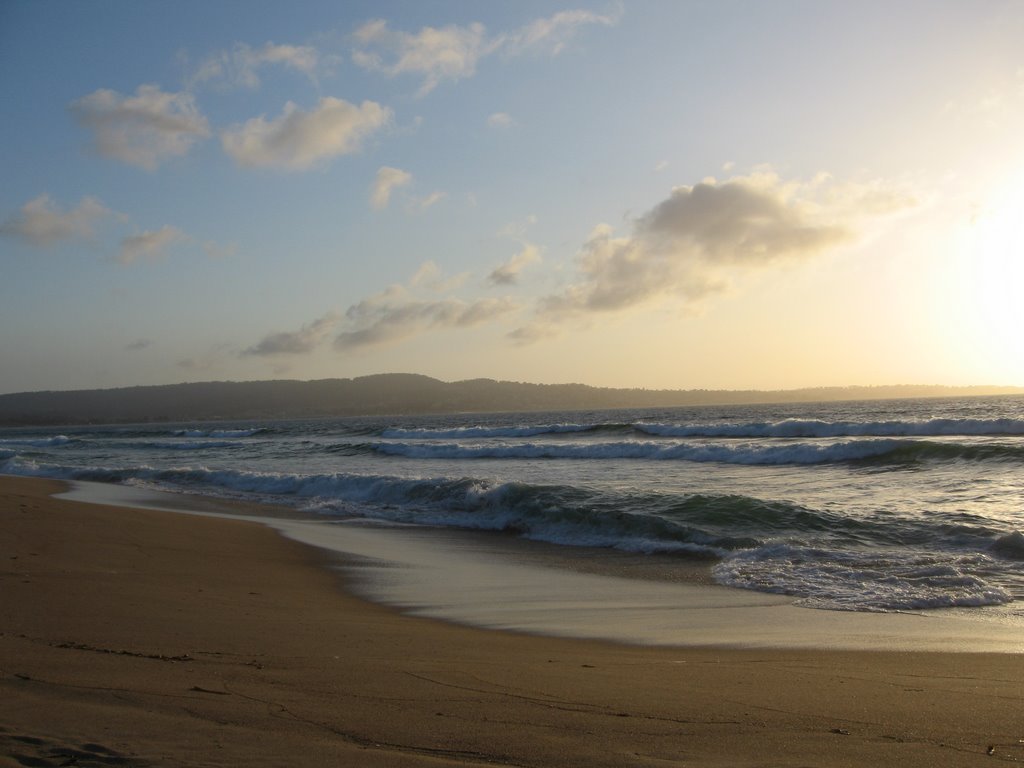
The shore at Seaside, north of Monterey, with Pacific grove in the distance.

Wednesday, May 03, 2006

Advertising 102.

May 3, Solvang.

Sometime last year Jim Judkins, the owner of Circus Chimera started experimenting with mass mailings as an advertising tactic, and this year the sight of stacks upon stacks of United States Post Office crates filling with envelopes has become a familiar one around the circus.
On days when they don't set up or take down the tent, up to 35 workers sit in the cookhouse tent and fill envelopes with $3 coupons and passes. The envelopes are mailed to every business in town for every given town. The system is fine-tuned so that for a small town like Solvang the circus covers not only the town itself but others around, and in turn in a big city like San Jose only specific businesses are targeted.
There is also not the same amount of advertising for two days of playing a town than there is for one where the circus will stay a week. "There is no cookie-cutter way to do it," says Jim, who analyzes every town to determine what is the best way to cover it. "We look at the market and try to decide what the intelligent way to promote it is," he says.
In all it costs Circus Chimera about two thousand dollars a show to advertise through mass mailing, at a rate of one dollar per envelope to businesses and forty cents per postcard sent to residences. Other, older ways of advertising are still being used but it seems that the strategy has worked. "We are seeing the difference," says Jim.

I had a dream.

May 2, Solvang.

"Day without immigrants" across the country and it just so happens I'm stuck without news today of all days, as the wireless connection is being erratic.
But suddenly as Fridman is working outside on painting his rolla bolas we hear chants coming from up the road behind the circus and the trailers and turn to see a ribbon of high-school students marching down, waiving American and Mexican flags, adding their voice to the national chorus. Even in tiny Solvang, California, they were out, so I'm tempted to think the action will be successful.
"A Day without Mexicans," the movie, becoming reality: in my wildest dreams I couldn't have imagined it.

Monday, May 01, 2006

Salvage job.


May 1, Solvang, California.

Yesterday there were only two shows and Fridman and I left for the next town at 8 instead of 11 PM or more when we have the usual three shows. The trip was short, only about 73 miles from Los Osos down to Solvang, so we arrived at only 9:30 PM.
It felt wonderfully early, as we usually don't arrive until one AM or later the next day. It felt as if we had been granted an extra night to enjoy. The luxury: after Fridman was done helping Jim park the circus we watched another episode of The Sopranos, our addiction of the moment.

I noticed when I parked the trailer a bunch of bright orange wild flowers jutting out like a proud wedding bouquet a few feet away, incongruous and lonely among the field of weeds. Before long the flowers were trampled by the next trailer arriving on the lot so I grabbed a pair of scissors and went out to cut a few strands, trying to arrange the others in the hope they would survive this motorized assault and prop themselves back up in the morning to proclaim their fiery glory once again. Then the next trailer arrived, and the next, and the next. Suddenly realizing the imminence of the flowery annihilation, I ran out to salvage what could be, dashing out between the looming trailers, a woman with a mission.
This morning the flowers were wide open and seemed even brighter.
In Los Osos I made transplants of the big pink flowers covering the hill behind us, griffes de la reine as they are called in French.
My circus treats.

Sunday, April 30, 2006

Detachment.

April 29, Los Osos, California.

We left Ventura and the ocean behind, reluctantly. Even though Los Osos is also a coast town the circus is set up far from the water here. As Little Sister Priscilla said, the circus sets up in a place as if it were going to stay forever and the place becomes ours, if only for a day. Ventura was easy to claim.
But we had to leave, as always. This endless moving teaches you detachment in many ways, detachment from place as well as detachment from people, as friends come and go, to other shows, other places, other continents. No place is ever ours in the circus, just as eventually no place is anybody's to claim anywhere, we are just passing by here on earth - the foolishness of claiming anything, or anybody, as truly your own.
The circus life's constant rhythms of change is also a reminder of the need to begin each day anew and live in the present moment.
Taking care of a baby will do that, too. Dylan changes every day in an obvious manner (last week he grabbed his feet for the first time, tremendous accomplishment for a five-month-old) and it reminds me that each of us do, too, only in much subtler ways. We change physically, as our cells die and others replace them, we change inwardly, as our views are constantly shaped by our life, and as a result we're never looking at the same person in the mirror. Or as Thich Nhat Hanh says, it is never the same person walking down the same path.
The universality of all human thought across widely differing faiths and cultures, another useful cliché to remember for a saner world: what the Little Sisters see as a reaffirmation of their Catholic faith I see as Buddhist philosophy.

Thursday, April 27, 2006

The wanderer.


April 27, Ventura.

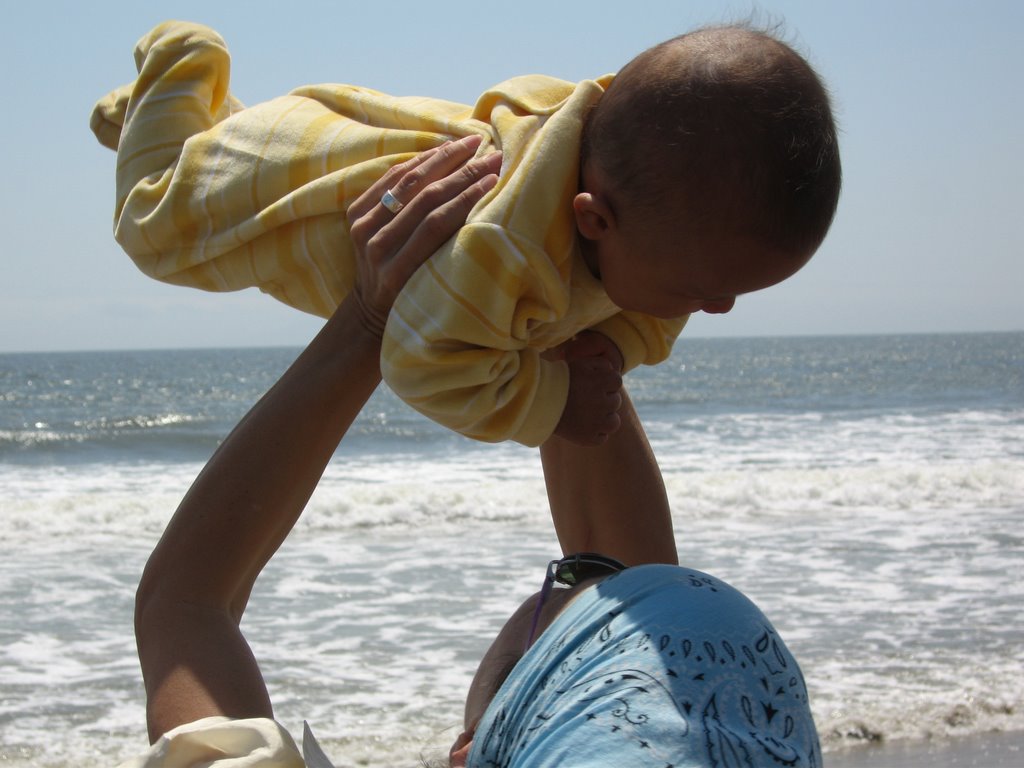
Dylan was born on the eastern seaboard, a few miles from the Atlantic ocean. Now he's crossed an entire continent and is taking in the Pacific. El bebe viajador.
He began traveling as a bunch of cells. He was conceived on the road, in Beaumont, Texas, where Fridman was contracted for a few shows, and then traveled - agárrate Fridmanito! - from Oklahoma to Florida and back, to Jersey City and New York City, on to France for a while, to Paris, the French Alps and the French Riviera, back to the States in Paris, Texas (hello, Wim Wenders,) and finally on to Savannah, Georgia, where he was born on November 14, a Monday.
Will he be a wanderer like his father and me? Living abroad you lose your ties to your country in a way that can't be undone and end up being from nowhere, a hundred times more so when you're constantly on the move. That's the price to pay for seeing more places in a month than most people will see in their lifetime. I often wonder if my son will miss that sense of being from a place, of belonging to a place the way people do when they are born and raised in the same town, the same house.
On the Sunday before he was born we had gone to the beach on Tybee island. I like to think he decided to join us the next day because he wanted to see the ocean, the wanderer's realm. Dylan is a Gaelic name that means "son of the sea."
He was not named with the sea in mind but after Bob Dylan, in honor of my brother, Patrick, who died at 29 in a car accident, and who simply revered the folk legend. The irony is that Patou didn't speak a word of English, learnt the words haphazardly studying the songs. I grew up listening to Bob Dylan and learnt the melodies by heart, his songs the background lyrics to my adolescence, their significance revealed years later.

If not for you,
Babe, I couldn't find the door,
Couldn't even see the floor,
I'd be sad and blue,
If not for you.

If not for you,
Babe, I'd lay awake all night,
Wait for the mornin' light
To shine in through,
But it would not be new,
If not for you.

If not for you
My sky would fall,
Rain would gather too.
Without your love I'd be nowhere at all,
I'd be lost if not for you,
And you know it's true.

If not for you
My sky would fall,
Rain would gather too.
Without your love I'd be nowhere at all,
Oh! What would I do
If not for you.

If not for you,
Winter would have no spring,
Couldn't hear the robin sing,
I just wouldn't have a clue,
Anyway it wouldn't ring true,
If not for you.
(Bob Dylan, If not for you, in the New Morning album, 1970.)

Wednesday, April 26, 2006

California surprises.

April 26, Ventura.

As I walked down the waterfront with Dylan asleep in the stroller I stopped to read information panels on the area's environment and learnt a few surprising things about this area of southern California.
Ventura's beaches line the Santa Barbara channel, "one of the biologically richest areas of the world. The channel is located in a biogeographic transition zone, where Northern and Southern marine plant and animal species mix when cold waters from the north and warm currents fro the south converge, producing a swirling eddy called the Santa Barbara Gyre."
In the distance you could see an island, faintly, and imagine others at its side, smaller. I learnt on another panel that those were part of the Channel Islands. The three islets on the left are the Anacapa Islands, and the big one on the right is called the Santa Cruz Island. These islands are home to more than 100 plant and animal species found nowhere else in the world.
Trying to learn a little bit every day, pour ne pas mourir idiote. The more you learn, you more there is to discover, the old cliché. The immensity of the task both a condemnation and the ultimate fun.

Tuesday, April 25, 2006

The first day.

April 25, Ventura.

There is nothing like the first day.
Out to greet the ocean again this morning and the world was altogether different. Nobody was out. Under a threatening sky the ocean like a stone. The sudden thought that you can't hear the ocean for the constant background noise of the freeway, a few hundred yards back (there is hardly a place in southern California you can go to escape that noise; it used to drive me crazy living in Riverside.)
There is nothing like the first day in a new town with the circus, everything fresh, like an early morning. I've always liked to get up at the crack of dawn and feel like the world belongs to me, all the hours of the day still ahead. It is the same feeling on that first day, and it disappears just as quickly as the passing hours erase that morning promise. Life in the circus is an endless renewal, un éternel recommencement, and for the looming unknown of the upcoming trip upon leaving town there is always the promising eternity of the few days ahead upon arriving in a new place.

Monday, April 24, 2006

Ocean view on the go.


April 24, Ventura, California.

This morning after the baby woke me up early I walked to the beach and introduced him to the Pacific ocean.
It was a perfect California morning: blue skies, soft breeze, jogging Moms pushing strollers, a forty-something hippie on a bike, surfers waiting for the wind to pick up, tall and toned and blond, the ocean deep blue.
The circus is set up at the Seaside Park in Ventura, a few yards from a surfers' beach. Think of it as a room with an ocean view for a few days, rent-free. It doesn't get much better than that.

Saturday, April 22, 2006

Men at work (circus glossary.)


April 22, Palmdale.

The Who's Who of Circus Chimera (work in progress):

Management
Jim Judkins: owner, big boss - United States
Roy Ordaz: manager, announcer, truck driver, boss - United States
Jay Summers: lights boss, truck driver, homme a tout faire (handyman) - United States
Martin Romero: tent manager, pony ride owner and manager - Mexico
Carlos Nunez (ie, el tio Tito): cook house manager, truck driver - Argentina
Armando Mendez Ventura: accountant, driver, the one everybody loves on Thursdays (pay day) - Mexico
Gustavo Gamero Aguilar: route planner, water supply provider, homme a tout faire (handyman) - Mexico
Jorge Cepeda Martinez: concession - Mexico
Francisco Platas Hernandez: lights - Mexico


Performers
Ekaterina Bazarova: contortionist and gymnast, playing Alice - Russia
Marvin Parada Blanco: clown - Mexico
Fridman Torales Ríos: gymnast, playing the Mad Hatter (rolla bola) and the Cheshire Cat (upside down walk) - Perú
"the Russians":
Evgueni Naidenkine (ie, Genia): clown, pater familias
Bérengère Naidenkine: hulla hoop act, playing the Caterpillar, step-Mom, the other Frog
Vilen Naidenkine: gymnast, strap act, eldest son
Alexandre Naidenkine (ie, Sasha): gymnast, strap act, youngest son
the Chinese: four girls and four boys, names pending transcription

Other workers
Rosalino Aburto Gonzalez (ie, Charlie) and Edith Gonzalez Mora: rides and tent worker and office femme a tout faire (multi-task office woman), respectively, married with a baby
Rafael Herrera Mancilla: cook
Maria Luisa Bello Gallindo: cook
Oscar Ventura Galvez: tent, driver
Higinio Alvarez Salazar (ie, Fuji): lights worker, driver
Aldo Roano Hernandez: tent, driver
Efrain Tochihuitl Hueletl: tent, driver
Saul Perez Mora: tent worker, coloring book artist
Isauro Colio Apodaca: tent
Fernando Perez Mora: tent
Agustin Rivera Chavez: tent
Melecio Rivera Chavez: tent
Celerino Rivera Chavez: tent
Arturo Apolinar Barrios: tent
Carlos Apolinar Barrios: tent
Cesar Mena Roman: tent, music
Sergio Mena Roman: tent, office
Corey Duggan: tent, only gringo in that group.
(list not extensive) - all are from Mexico except Corey.

Circus Chimera cast (March.)

Dylan et al.


April 22, Palmdale.

Just felt like posting pictures of Dylan and us.
Taken by my friend Carrie last Thursday in Hemet.
Maybe because I finally found that documentary movie by Martin Scorsese on Bob Dylan I so wanted to see?

Friday, April 21, 2006

Ups and downs.


April 21, Palmdale, California.

For what it cost Circus Chimera to play Big Bear Lake you could buy yourself a nice little car, brand new. The rides up and down the San Bernardino mountains cost a total of more than $13,000 in repairs to pickup trucks, vans and semis.
Big Bear Lake, a scenic ski and hiking resort, sits at 6,754 feet in the San Bernardino mountains above the Inland Empire area. State highway 18 goes up to the village on either side of the mountains, and either way it is a steep road, only a shorter one on the east side from Apple Valley, the way the circus went.
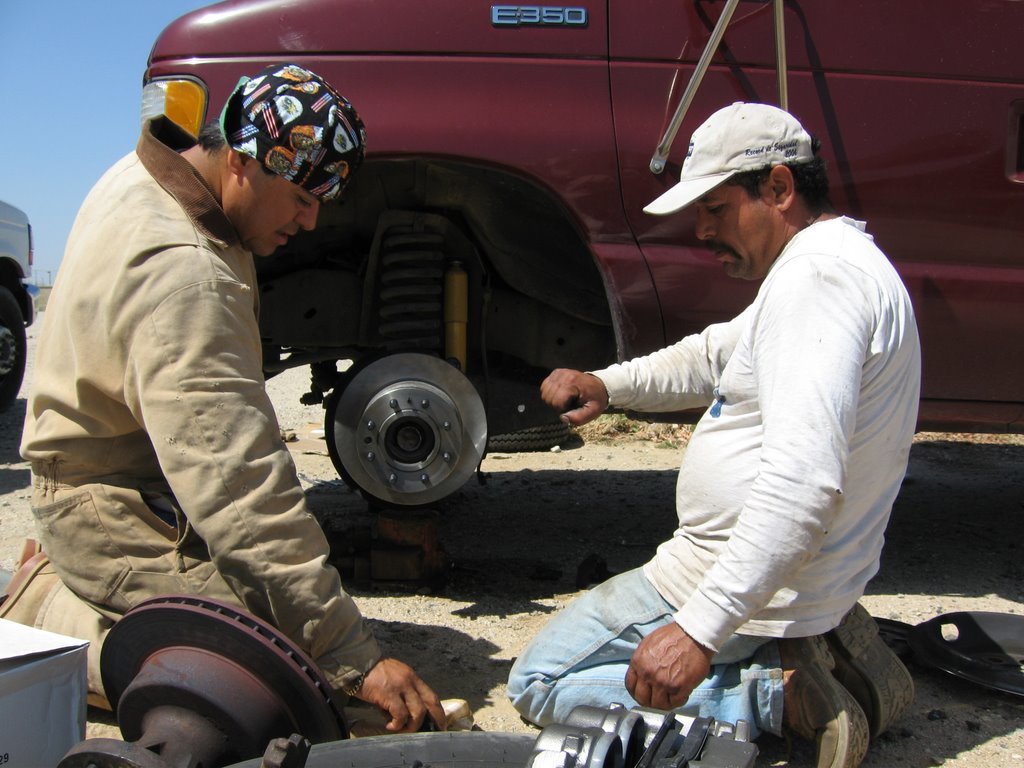
On the way up two big rigs didn't make it, their differentials broken, "the rear end," as Jay said. El tio Tito and others had to drive down to haul them up the rest of the way with other trucks, working until 4 o'clock in the morning. Cost of the adventure: $10,000 in parts and diesel. As with everything else in the circus, the work is done in-house, by Jose Lopez, the circus' mechanic, and others. The two differentials were fixed only a few minutes before the circus left on Wednesday night. And that was only half the trip, the most dangerous one by far still ahead.
The sign at the start of the downhill stretch said: "Caution, Trucks Go Slow,16% grade next 6 miles." All of the circus' private trucks and trailers except ours and the truck hauling Charlie and Edith's trailer lost their brakes during the downhill trip, which seemed a lot longer than six miles.
Both Jim's truck and trailer brakes caught on fire and he had to use his fire extinguisher to put it out. The brakes on the truck hauling Marvin's house also caught on fire, with Goyo at the wheel, as well as the brakes on the trailer. The brakes on Jay's truck, with Charlie driving, the brakes on el tio Tito's truck, with Oscar driving, and the brakes on the little truck hauling the restrooms all gave way. Aldo was driving that one and when his brakes didn't respond he managed to stop by driving off into the side of the road. He was almost there: half a mile more and the road finally leveled off. The brakes on the big common fifth-wheel trailer, driven by Armando, and the ones on both Roy's truck and trailer also gave way.
The truck hauling the shop, with Fuji at the wheel, burnt its brakes halfway down and went on down the hill butting against the truck hauling the plant, with Jay at the wheel. "Between my truck and the shop's, I was holding about 125,000 pounds," said Jay. The plant truck, a double-load big rig, weighs about 80,000 pounds, and the shop truck, a small pickup, about 33,000.
"Three thousand dollars in brakes," said Jay. "So far."
But nobody was hurt, everybody made it down the hill and to the next town. People at Circus Chimera will not forget Big Bear Lake any time soon, but this is not the only challenge it will have to face.
There is still a long road ahead.

Martin Romo Silva (left) and Jose Lopez Sauceda at work replacing the front brakes on Martin's truck.

Wednesday, April 19, 2006

Carpe diem.

April 19, Big Bear Lake.

My friends Carrie and Silvia came by again for dinner last night from Riverside. They are photojournalists at The Press-Enteprise, they were my colleagues when I was working there.
I miss shooting with them. I miss shooting. I miss being out there every day and making pictures, meeting new people, being cold and being hot, being tired and being bored, learning every day, not ever doing the same thing every day. I miss the camaraderie, my photojournalist friends. I miss the newsroom, the hustle and bustle, the deadlines, the adrenaline. I miss being a daily photojournalist.

There wouldn't be no Dylan if I had stayed there.
How I would miss his very existence.

Tuesday, April 18, 2006

Petite Soeur Priscilla et le funambule (rough draft.)


April 18, Big Bear Lake.

Little Sister Priscilla was born in the circus. Taking the vows of the Little Sisters of Jesus Catholic congregation did nothing to stop her from spending her life in it, on the contrary.
It is a familiar story for circus people: her mother met her father, a circus performer, and joined the circus. He was from a Swiss circus family, the Bühlmanns, a high wire artist. Un funambule. He died after falling during a performance where he rode a motorcycle on the wire when Priscilla was just four. She was born in 1931 in Morges, in Switzerland, near Lausanne, because that's where the circus was at the time. Priscilla was up on the high wire with her mother before she was born. "Mom walked the high wire with me in her belly up til when she was seven or eight month pregnant," she said.
After her father's death her mother took her and her one-year-old sister to live with her grandmother in Lausanne. She didn't have a profession so she worked as a waitress. When Priscilla was a teenager she wanted to go to boarding school but was refused entrance when it was found out that she was from a circus family. She took to hiding her background after that, and distancing herself from circus life. But destiny had something else in mind, or the Lord did, she would say. She joined the congregation of the the Little Sisters of Jesus in 1953 and took her final vows in 1961. "I wished to work in a factory," she said, but the Little Sisters found out about her family and Little Sister Magdeleine, the founder of the order, encouraged her to go back to the circus. Little Sister Magdeleine, or Magdeleine Hutin, as she was known before taking the vows, founded the Little Sisters of Jesus following the path of Brother Charles de Foucauld, a monk who chose to live an eremitic life among Muslim desert tribes in North Africa at the beginning of the twentieth century and founded a spiritual family from which sprung several orders within the Catholic church in France.
Little Sister Priscilla joined the Little Sisters at Circus Knie in 1961, and she's been on the road ever since. After working with several circuses in Europe she came to the United States following Little Sister Magdeleine's wish to see the sisters increase their presence on other continents. The Little Sisters order has about 1,200 members. It is based in France but is present around the world, from Afghanistan to Vietnam, including Iraq. There was already a group in the U.S. and Little Sister Joelle had expressed the desire to work in a circus; Little Sister Priscilla joined her in Washington D.C. in 1968. They've been on the road together in the U.S. for 28 years.
Little Sister Priscilla turns 75 this year, and she and Little Sister Jo, who's in her sixties, decided not to travel full-time anymore. From now on they will work with a circus for a while then take the rest of the year to go into retreats and stay with different Little Sisters' congregations in the U.S.
Little Sisters Priscilla and Hélene-Renée left yesterday. We didn't say goodbye, they don't like to. We'll see each other down the road, here or there, in the circus.

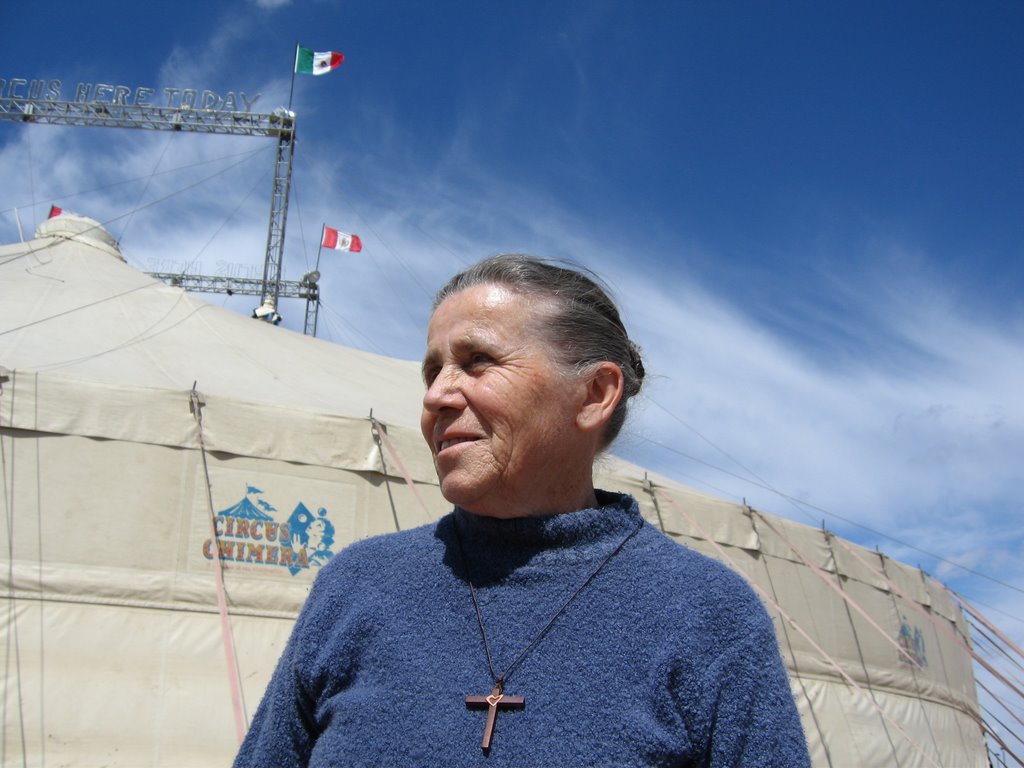
Little Sister Priscilla in front of Circus Chimera (April 1.)

Glorious moon.

April 17, Big Bear Lake, California.

Two of the circus trucks didn't make it to Big Bear Lake, up in the San Bernardino mountains.
In order to avoid the longer road up the mountains from Hemet down in the valley, Gustavo, the "24-hour man," who maps the route for the circus among many other things, had us go all around them via the I-215 and 15 freeways to California state highway 18 on the other side of the San Bernardino National Forest, instead of driving up that same road from the Riverside area. The stretch of mountain road on the desert side is three times as short but it is just as steep, and two of the big rigs gave up half way to the top.
Our Dodge truck, a 3500 dually diesel engine truck, was struggling all the way, and we were worried about it too, but it did fine. I went all the way up at 15, 20 miles an hour in second gear, watching the gauge for signs of overheating, alternatively behind and in front of Fridman and his big rig.
The road was beautiful. I don't remember driving it when I was working in the area because we would always drove from the west side. Near the top of the ridge we were greeted by a glorious moon, jumping out in front of us, bathing the whole mountain in silver light, disappearing behind a curve and startling us again around the next, playing hide and seek, big enough to touch.
And this morning I woke up to the sight of a mountain slope draped in immaculate snow. Big Bear was one of the few good things about living in Riverside.

Monday, April 17, 2006

An Easter parable.


April 16, Hemet.

I, the non-believer, had hoped for a miracle. I'd hung on to the belief that my cat would come back to me on Easter.
She did.
We found Gramo after the Easter mass last night. She was inside the wooden boxes that close the ring. Sister Priscilla came knocking on the door of our trailer to say that they were hearing a cat crying somewhere in the ring; we rushed back to the tent in time to see her running out like a fury, terrorized. It took three of us to corner her behind the ring's curtain.
She could have manifested herself during the Thursday mass and the Friday congregation, but she chose Easter. This morning I'd written my mother about the symbolism of Easter - rebirth, regeneration, Christ coming back - and how I wished Gramo would come back to me then. This was one of the times when I wished I were a believer, I added. If there had been more people at mass they wouldn't have heard her. She would have come out when they were taking down the tent tomorrow night, and she would have panicked at the noise and chaos and run away again, probably never to be found. She waited for the end of the Easter mass and cried.
Voila, c'est Paques. I hugged the Little Sisters and then hugged them again, my little blue-eyed cat in my arms. This is Easter.

The mass began with a fire outside.
Father Bob said: right now this is only a bunch of twigs and paper; only when I light it will it be a fire. He was referring to the symbolism of Easter of course - there was darkness and then the light of Christ resurrected. To me it brought to mind the teachings of Buddhism on the ever changing quality of all living things: the fire is already present in the match.
After the symbolic lighting of the fire and of each person's candle there was a procession back inside the tent to the ring. Afterwards everyone was treated to a hot chocolate and Easter eggs. Father Bob took off his robe, said goodbye to the sisters and got into his rented PT Cruiser to go spend the night at the local parish before flying back to Cincinnati. I went back to the trailer to write this and ponder my epiphany.

There is something special about mass at the circus, even for a non-believer like me. Maybe it is the fleeting quality of life here, the not knowing if you'll be together tomorrow as friends are constantly separated and reunited again in travel, the detachment it teaches you, as Sister Priscilla said. Maybe it is the humility of life at the circus, the hard work and bare bones and simple things and simple joys. Maybe it's the similarity of this nomadic life with that of Jesus.

Happy Easter.

Friday, April 14, 2006

Rain.


April 15, Hemet.

Today it rained all day, and in my heart too.

There was a mass in the tent last night, the first of the Holy Thursday, Good Friday and Easter Sunday trilogy. The Thursday mass is called the Evening Mass of the Lord's Supper.
As with the mass this month this one was held in the tent, around the ring. Father Robert Poandl flew in on Wednesday from Cincinnati. He belongs to the Glenmary Home Mission, a North American religious group dedicated to the poor, and used to be a priest in Hugo, Oklahoma, a small town home to several circuses and where Circus Chimera has its offices. There were about 25 to 30 people attending. Sometime towards the middle of the mass, Father Bob asked for volunteers for the ritual washing of the feet. "The dirtiest feet first," he said, breaking the ice. Thirteen people came up - or twelve and a half, the priest joked, as one of them was Marvin, the midget clown. They sat down in the ring, and took their shoes and socks off. Luckily this was a warm and balmy night in southern California.
The service ended with a procession for the transfer of the Holy Eucharist to the Little Sisters' chapel. The chapel is in the back of their truck, but many people had never seen it. They went in three at a time, after the eucharist was placed there symbolically.

I missed the mass entirely because I was looking for Gramo, my little blue-eyed cat, after walking the streets all day calling her.
It became evident that I'd lost her for good early this morning when I opened my door to a silent lot. I'd hoped the quiet of the night would let her find her way back to us and I'd open the door and find her there, waiting for me.
I'm heartbroken beyond what I could imagine possible, this being a pet after all. I lost Yogi, my other cat, once, many years ago, when a roommate took him and dumped him off on the side of the road 18 miles away, as I found out later. Yogi came back. I don't know how, but he found his way back, crossing highways and suburbs,and nearly starving to death. It took him three weeks. I wish I had that kind of time to let Gramo find me. My only consolation is that she was born on the streets so I know she'll be OK taking care of herself out there, she's a tough cookie. The other possibility is that someone took her, disregarding the fact that, being well fed and wearing a collar, she's obviously somebody else's pet. Judging from the number of abandoned cats we saw in the Hemet animal shelter today, there is no end to people's selfishness.
Ugliness is all around.

Thursday, April 13, 2006

Win some, lose some.


April 13, Hemet.

Good news: my friends Carrie and Silvia came by today to visit and meet Dylan.
They were my colleagues at The Press-Enterprise and are two great photojournalists.

Sad news: Gramo, one of my cats, got lost last night, slipped out of the trailer and never came back, probably got chased off by a stray or just got scared and run off. I only stop crying when Dylan smiles, which luckily is often. It's hard to be sad for long with a baby around.

Three girls and a baby: Silvia, Dylan, Mudshowgal and Carrie.

Saul's dream (rough draft.)


April 13, Hemet.

Saul Perez Maro, 25, is of medium height, strongly built. He's prompt to laugh and his laugh is especially contagious. He is one of the crew of tent workers at Circus Chimera, where he also works with the ponies.
Saul is deaf by birth. He was born and raised in Talapacoyan, a small town in the state of Veracruz, in southern Mexico. Of his three siblings two are hearing; an elder brother who died young of cancer and Fernando, his other brother, who is with him at Circus Chimera. His sister is deaf; she works as a seamstress in Mexico. Saul came to the United States thanks to a chance encounter with Jim Judkins, Circus Chimera's owner. He flourished there mainly as a result of Jim's dedication.
When Jim was visiting at the house of his recruiting liaison in Mexico he was asked if there could be a job for three deaf workers. "I said why not, they're like everybody else, they can work like anybody else," he recalled, adding his own comments while interpreting Saul's signing during an interview. Jim brought only two of the three youth to Circus Chimera with him that year, Arturo and Saul. The mother of the third one was scared, he said, of what would happen to her son. Agustin came a year later.
Saul and his deaf friends didn't know how to read and write, and they had their own sign language. There was no school for the deaf or other accommodations for deaf children in Talapacoyan, so there was no possibility for a school education.
Once they got the circus in the United States Jim looked for ways to help them learn. "We got children's books, pictures, dictionaries, we got on the internet and looked for sign language," Jim said as he told me how they went about to teach the youth to read, write and sign. "We would write down the English and Spanish word and then sign it. It took seven months before they would get it; they're smart but they had to get the idea. Once the light struck it was very rewarding." Saul, Arturo and Agustin learnt English sign language because it was the only one Jim could find on the internet.
Saul still can't read a book but he's got the basic concept of how to read and write. He's also become something of an artist: he's now drawing for the coloring books the circus sells at intermission. Jim was also proud to say that he got him his driver's license.
When asked if he dreamt of something for himself when he was growing up it was evident that the very notion was entirely foreign to him. I realized then how very specific to affluent societies that notion is. Talapacoyan is in the southern part of Mexico, a poor, underdeveloped region. It is an agricultural town. The only two jobs there are picking fruit or being a carpenter.
That's what Saul wanted to do until Jim came around. Saul's Dad left when he was three years old and his mother worked in a tortilla factory baking tortilla to support the family. Now he's sending money home to her so his family can have their own house. Only he sends money; his brother Fernando has his own family to support in Mexico. Saul's already bought the land and they're building a house on it. He's got a girlfriend too and is starting a family: she's now pregnant.
Saul doesn't need to have a dream; he has something better: for the first time in his life, a future on his own terms.

Casual bedfellows.

April 11, Hemet, California.

The Little Sisters traveled with a mouse since Brownsville, Texas, where the circus started the season back in January. It didn't do much damage to their food supplies so they didn't mind it that much. They never even saw the thing. And they found out that it had stacked grains of rice in the rock cradle of a tiny baby Jesus plastic doll they have on the mantel around their kitchen table. It brought the rice there from a bag under the sink, little by little, accumulating a little cache, making the doll a pillow. Then it left. That rock didn't look comfortable to me either.

Physical for Dylan today, finally. $120 for 10 minutes, everything OK, he's strong as a mini horse: 7 kgs 3 (16 pounds) and 63 cm (23 inches.) "Chunky," I think the doc called him. We're trying to figure out where he gets that from, since Fridman is 5 feet 3 and an athlete with no fat to be found anywhere on his body and I'm 5 feet 2 and what people like to call petite (a broad generic adjective meaning small or short in French that is used to describe anything from a planet to a ladybug.)

Interview yesterday with Saul Perez Maro, one of the tent workers, with Jim interpreting since Saul is deaf and mute. If this was a strict journalistic piece there would be a problem here since Jim is Saul's boss, but I'm making the rules as I go, and there are no other possibilities at the circus for sign language interpreting anyway.
He had asked me to take pictures of him when he's at work, and for my project too I wanted to talk to one the three deaf and mute workers Jim brought from Mexico; I always thought they would make a great story. So the interview was for both the project and for a new section on the behind the scenes at the circus I'm working on for the Chimera web site. Turns out I was right, Saul's life makes for a typical immigrant's hard work and overcoming the odds parable, always a great story.

Monday, April 10, 2006

Crash.

April 10, Hesperia.

It's a little after six o' clock in the morning and the baby just woke me up. Fridman and I went to bed at 2 AM. Dylan didn't take any naps again yesterday and needed constant attention from when he woke up at 7 AM until 9 PM when he finally crashed. I wish the little buggers came with a user's manual. And I'm going to have to start going to bed earlier if I don't want to crash myself.
Good thing is, between the baby, the laundry, cleaning the house, cooking, working on the web and trying to take pictures a person hardly ever gets bored.

Sunday, April 09, 2006

Tent tales (unfolding.)


April 9, Hesperia.

More on the circus tent, or how a giant rises every other day.
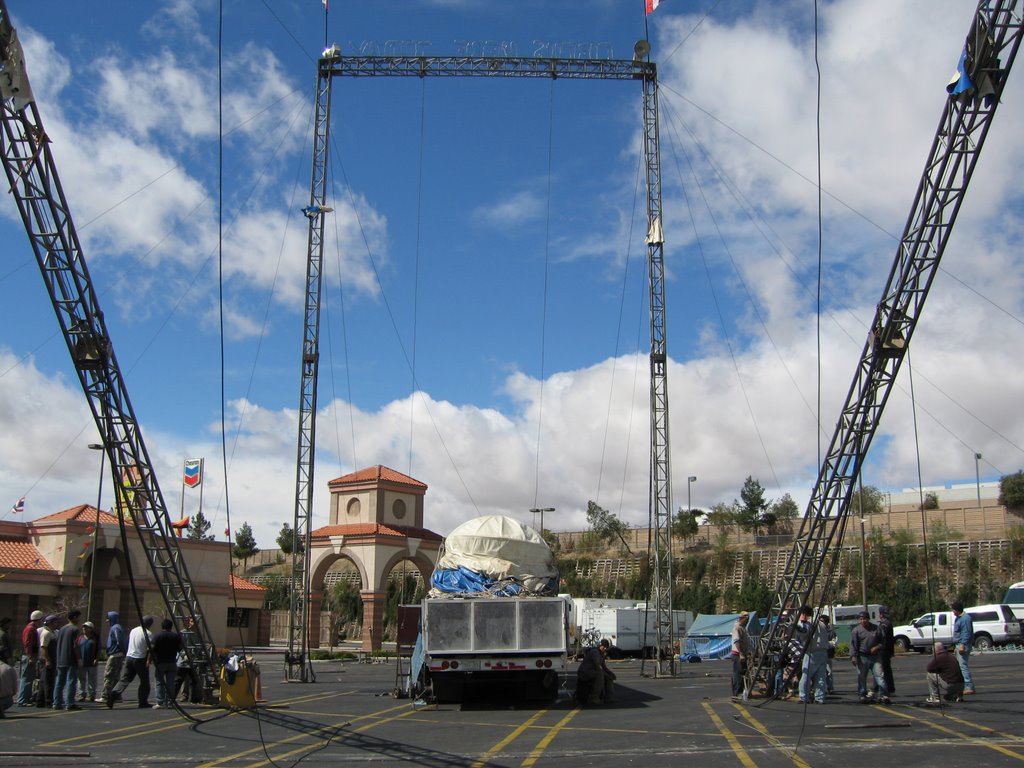
It never ceases to amaze me how sheer arm power, or this little group of some 30 Mexican guys, sets up a tent that big and everything in it in such a short time. Everyone knows its role, there is not a second lost, it's like a well-oiled factory in the open, and one minute you're in the middle of a normal parking lot, the next there's a huge tent there, flags flowing in the wind and the 1000-and-some seats inside all neatly lined up. It's done in less than five hours. Martin Romero, of Mexico, is in charge.
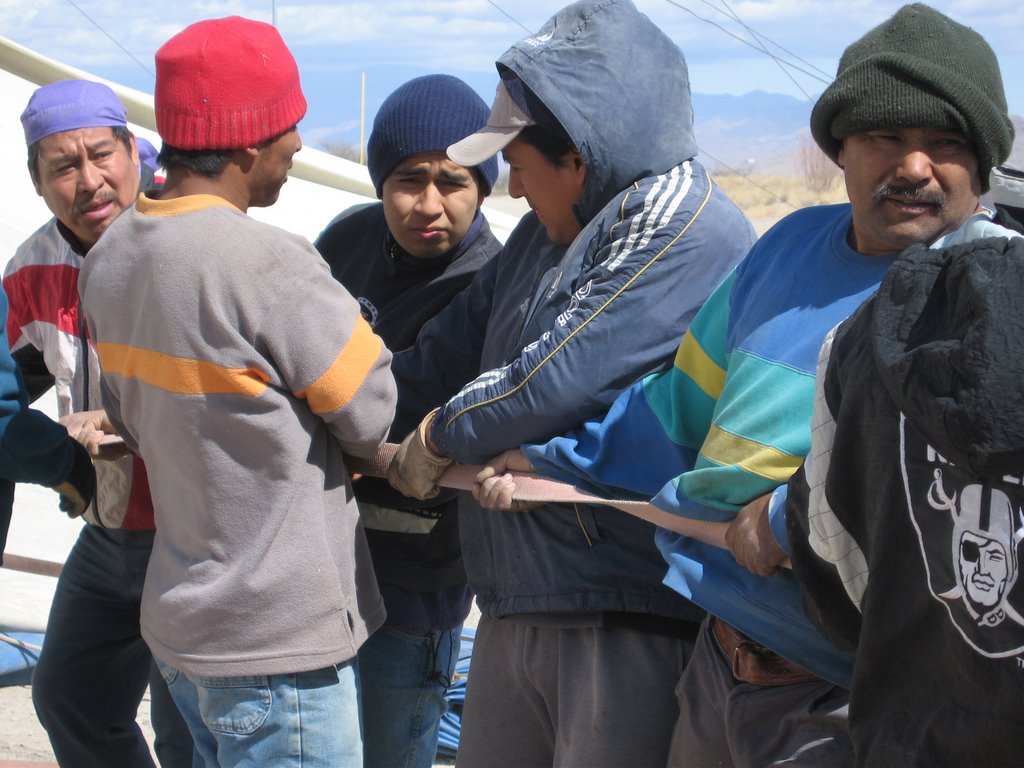
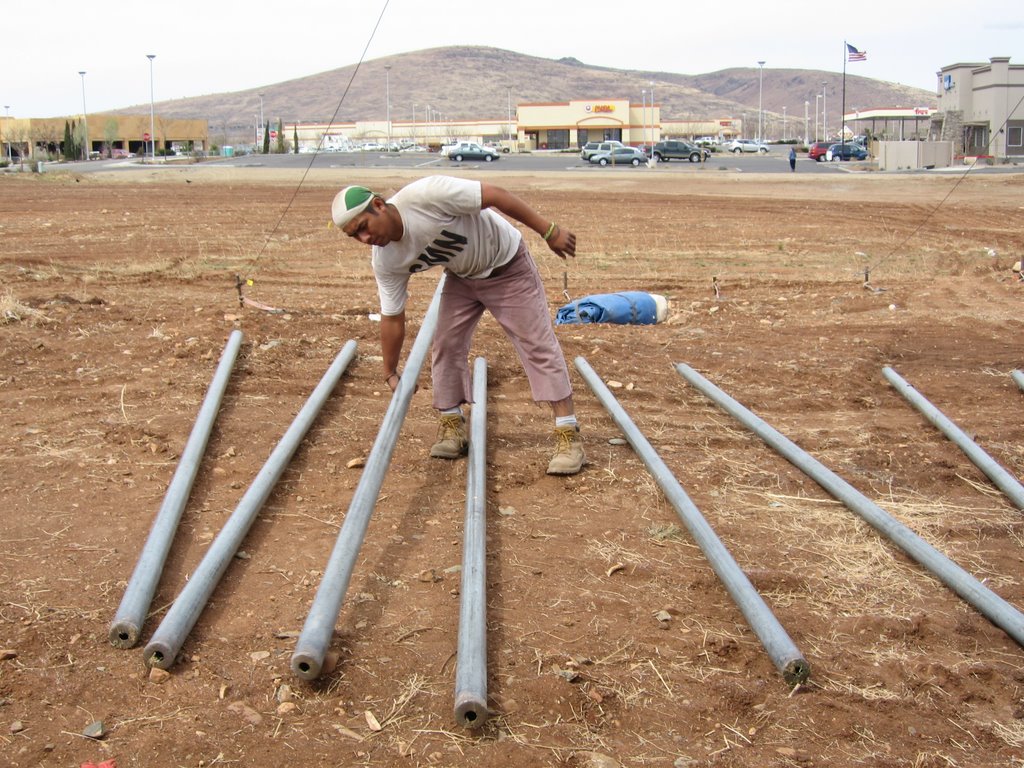
It goes something like this. First all the stakes that anchor the tent are driven into the ground, or sometimes asphalt, by a truck. The metallic pounding sound has become familiar; its rythms the mornings in which we set up in a new town. Since it only takes a couple of guys to do that job, most workers take the opportunity to have breakfast during that time. Then the truck with the tent on its bed positions itself in the exact middle of the area where the tent is going to be raised. From the bottom of the bed workers in groups of a dozen take out the four steel beams that will be the structure of the tent, in four pieces they assemble on the ground plus two pieces that go across at the top. Each piece is about 15 meters long. They are then raised with a system of cables and hand pully and good old-fashioned arm strength (see photo.up )
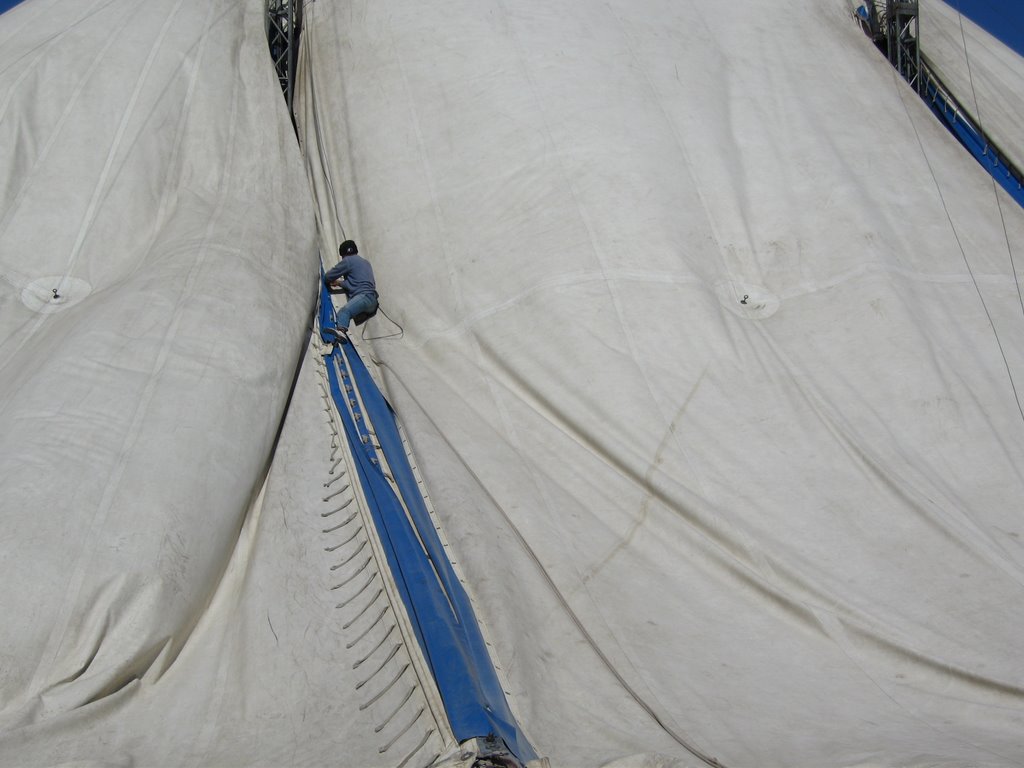
Next the tent is pulled off the bed of the truck and up to the top and from there unfolded in four successive panes, each one being carried off the truck to the anchor stakes by a group of two dozen workers. The panes are tied to each stake around the whole circumference of the tent and tightened, and two workers then tie them together from the ground to the top of the tent. Meanwhile the other workers are setting up the stands, benches, chairs and ring as the electricity crew sets up and wires all the lights and the sound crew the music equipment.
Outside all the while others have been setting up the various rides and attractions that line the entrance to the tent. There is also the pony rides; it's Saul's job to take the ponies out of their trailer, clean and feed them and get them ready for the day (more on Saul on a later posting.) Finally the concession people have also been getting their truck ready for the day's business, shopping for supplies and loading them up.
We on the performers' side, meanwhile, have been happily sleeping the morning away after a late night driving to the lot, and gradually emerge to go about hooking our trailers up, the water will usually come much later, stepping out to find the tent shining in the mid-day, the giant arisen once again. For a couple of days, until the next resurrection.

Photo 1
The beams are raised (April 5.)

Photo 2
Securing the tent to the anchor stakes (March 27.)

Photo 3
Securing the tent panes together (March 8.)

Saturday, April 08, 2006

Adding Alice.


April 8, Hesperia.

Jim and Roy have started making changes to the show to make it more Alice in Wonderland-like.
That's the theme of this year's show but until now it has not been much, well, showing (somebody give me a thesaurus, for God's sake.) The problem was that Guennadi (artistic director, master clown) had started working on it but he was thrown out on the eve of the opening so it stayed sort of half baked, with an Alice opening and finale and not much related to the story in between. Like Bérengere's hulla hoop act with her fishnet stockings and high black boots and its heavy metal music. In the new and improved version Marvin the midget clown runs around the ring at intervals during the show to Roy's voice-over of "It's late! It's late!" and Bérengere will have to work the hulla hoops in a caterpillar costume, complete with little feet dangling from her legs. Her sons, Sasha and Vilen, will do their strap act in the same costumes they're using, sort of army green leotard, but with huge masks added, which might be a slight problem when they work head to head. A seamstress, a friend of the Little Sisters called Ann, should be here next week to do the new costumes. At this time this is I can report concerning the show's updates at Circus Chimera. Most days now I'm stuck in the trailer because it's become hard to go out with Dylan and sit still for more than about three minutes, and he hardly sleeps at all during the day anymore. Like Fridman kindly said earlier today, you wanted a baby, take it.
In the bad news department, the Little Sisters are not staying until the end of May, as I thought, but only until the 18 of this month, just after Easter, that is, barely more than a week from now. So quickly gone. We'll lose our guardian angels and Dylan his most fervent admirer.

Dylan de cinq a sept.

Glory days.

April 7, Hesperia, California.

I stepped out this morning to see the San Bernardino mountains gloriously capped in white.
Southern California saw heavy rainfall in the past few days and that means snow in the mountains. Memory lane: when I lived in Riverside I remember days like this when you'd be among palm trees and look up to see snow-capped mountains in the distance, glowing fiercely in the Southern California sun. Nice. Reality check: it would happen about twice a year because the rest of the time you couldn't see past your windshield for the smog.

The Russians are back!

April 6, Barstow.

They arrived in the late afternoon today after four days of non-stop driving, all the way from Pennsylvania where they had a show engagement. Genia looked like a character out of a Jim Jarmush movie, I'm thinking Stranger than Paradise, his blond hair all tousled and a three-day beard. They'll be back in the show tomorrow.

Thursday, April 06, 2006

Tent tales.


April 5, Barstow, California.

The circus is parked on a shopping mall parking lot hardly bigger than the circumference of the tent.
The tent is a little more than 16, 000 feet square feet, extending to some 20, 000 if you count the area covered by the anchor stakes and the area we had to park in is probably about 30, 000 square feet. In it you had to fit seven double-load trucks and eight trailers, keeping in mind safety rules and access.
Under pouring rain and after driving some two and a half hours of a dangerously wet mountain desert road from Twentynine Palms last night, Fridman somehow managed to do that. I waited for him until four, then went to bed. The baby woke me up at seven.

Exact dimensions of the Circus Chimera tent:
147 feet from sidewall to sidewall (or 45 meters)
180 diameter from stakeline to stakeline
210 diameter from anchor stake to anchor stake
Total square feet inside the tent: 16, 365
Maximum seating: approximately 1,600.
The tent is designed and built by Canobbio, an Italian company among the best in the business.

Setting up the tent (February 9.)

Morning prayers, Marines.


April 4, Twentynine Palms.

This morning Sister Priscilla was praying by the little pond behind the circus when she heard some noises and turned to find Marines in full combat gear crawling in the sand.
The little sisters have a gift for finding places and things of beauty everywhere they go to with the circus, no matter how ugly and forlorn the surroundings. When they find this place they go there to pray, or just to find peace. I remember visiting them at the Carson and Barnes Circus and on the table in their trailer there would be a little bunch of wild flowers, or just one flower sometimes, or a rock with a distinct shape one of them had found during a walk. A celebration of beauty, joy and life in the simplest form. The dashboard of their truck is lined with odd-shaped roots and wood, rocks and pebbles. A testimony to the Little Sisters' religious reverence for life and all things there, but also of their humility and integrity. It is a reflection of their faith but goes beyond that to embrace us in love. It reminds me of the teachings of Thich Nhat Hanh, a wonderful Buddhist monk from Vietnam I admire and look to for inspiration and guidance.
Here at the base there was a salt pond right behind the tent. In itself it was not beautiful or even natural but in a grove of trees nestled on its shore (I need to look up what kind of trees they are) one miraculously entered an oasis of nature and peace. That's where Sister Priscilla went to sit down and pray, until the Marine surprise.

Monday, April 03, 2006

Joshua dreams.


April 3, Twentynine Palms Marine Base, California.

Back in California, where I used to live.
I worked as a photojournalist with The Press-Enterprise, a newspaper based in Riverside, an hour east of Los Angeles. Or Homicide Riverside, as my friend and fellow Press-Enteprise photojournalist Carrie calls it. The area is called the Inland Empire, a rather bombastic name as they go. Riverside county and San Bernardino county, its neighbor, share the sad distinction of being the most polluted region of the country. All the smog from the Los Angeles area gets pushed by ocean-born winds plus its own sitting above it like a dirty camisole, blocked there by the San Bernardino mountains to the east. it is also a congested, expensive stretch of parched land, where no matter where you go the buzz of the freeway is always present, a faithful and appropriate companion to the smog.
I was glad to leave, the I-10 East my highway to freedom and an uncertain future that I didn't know then would include a new life. I didn't think I would ever come back. I went as far away as I could, back home on the other side of the Atlantic, and on this side of it as far east as I could, in Savannah. Then I joined the circus.
It is parked at the Marine base in Twentynine Palms today (the exact name is the Marine Corps Air Ground Combat Center.) The base was surprisingly easy to enter, all you needed was the little piece of paper they had given us at the office before leaving that said "Circus Chimera vehicle." Homeland security. I can only hope there is better surveillance of vehicles moving inside the base. Then again I wouldn't be surprised if there isn't.
I knew Twentynine Palms for having covered the drowning of two women and a child in a flash-flood incident there, among other things, when I photographed for the paper. Not exactly a happy memory; taking pictures of people that have just gone through horrendous personal events has always been my least favorite part of being a photojournalist. The town is a sad-looking place at the door of one of the most beautiful natural areas in this country, the Joshua Tree National Park. In my two and a half years in Southern California I managed not to go there even once, and now it looks like I'm going to have to skip the opportunity again. Growing up in France Joshua Tree was an utterly exotic and fabled place you'd want to go see for yourself once. I know it was also one of my brother Patrick's favorite places to dream of, that and the Mojave Desert that we skirted last night on our way here from Arizona. I thought of him as I was driving on the deserted highway in its shroud of obscurity, miles and miles of empty lonely road. He had wanted to come to Joshua Tree, had loved the desert without ever knowing it. He died at 29. It was in 1993 and I miss him every day.
Today he's with me in the California desert, in the sand and the wind and the Joshua trees.

Photo 1
The evening redness in the West (or hommage to Cormac McCarthy.)

Photo 2
Salty pond behind the circus.

Note on the blog.

April 2, Kingman.

I just realized I'd somehow erased the first entry to this blog explaining what it was about so a little bit of background information is called for here.
I launched this blog when I started working at the Circus Chimera, as a tool to help me track progress in a documentary project I'm trying to do on the Circus Chimera. The project has been a long time coming, as I've had it in the back of my mind ever since I met Fridman, my boyfriend and a circus performer, in 2000. He was then with another circus, Carson and Barnes (which would call for another type of project altogether, more like an investigative journalism piece.)
The project is to document this circus, a mosaic of people from around the world who live, work and travel together for ten month out of the year, seven days a week. It is based in Texas and travels through the West. The project was meant to be purely a photography documentary project at first but I have then decided to make it more of a multimedia endeavor, including text, interviews and stories, audio interviews and possibly some video.
All this while taking care of a baby and working part-time for the circus.
Rendez-vous in eight months for the outcome.

Saturday, April 01, 2006

On the road.


April 1, Kingman.

Dylan is now four-and-a-half month old and a chubby happy little guy. I call him my "bibendum Michelin," after the Michelin ad character full of inflated tires.
I feel guilty that I haven't said a word about him in such a long time, when he fills my days. He's my joy, my challenge, my sun and my stars, my most important job, my everything, how could it be otherwise? I'm a new Mom.
Lately he started being difficult at nursing time, crying and refusing the breast when I know he's hungry, and I have to struggle with him for a while before he finally settles down to a normal, calm feeding. I suspect it has something to do with teething, but being a new Mom I have really no idea. The difficulty is compounded when we have to travel at night, because this is also when this strange new behavior is at its peak. It becomes a bit of a stressful wrestle, because when Fridman's truck is ready he has to leave right away, and in turn have to be ready to roll with the baby then no matter what. Furthermore Dylan seems to have settled into a routine of multiple feedings in the evening as well, so from 6 PM on or sometimes earlier it is a non-stop nursing marathon from which I emerge utterly drained. When we have to drive 150 miles afterwards I'd give anything for a life of boring normality. Then we get on the road and I wake up again listening to the BBC news announcer on the satellite radio and you couldn't make me give this up for anything in the world.
The circus is a hard place to be with a baby to care for, undeniably. Every little challenge is exacerbated, there is no comfort zone. And I've been talking a lot about all the hardships that come with this nomadic way of life, Murphy's law and all, baby or no baby. But the circus is also a place of much beauty and meaning, and above all it has enabled me to be with my partner and my baby as a family, something that until now seemed unattainable given our very different obligations. I want to thank Jim Judkins, the owner of Circus Chimera and our boss, for giving me this opportunity. Without him Fridman wouldn't wake up to his son's smile every day.
We'll be just fine, the eighth wonder of the world and I.