June 23, Antioch.
Finally over with American Vertigo, the BHL book in the footsteps of Alexis de Tocqueville in America (see BHL entry.)
A French friend of mine had a good laugh reading a scalding review of the book by one of my favorite journalists, Garrison Keillor, in the New York Times online, and passed it on (Anne is the mother of the most adorable two-year-old, Alicia, and lives in Paris with her Colombian husband, a sequence artist. She's my trusted resource for advice on the many stumbling blocks and potholes on the motherhood road - my own private baby consultant.)
I still found the book enjoyable (can't undo the French in me?) as it is easily read, divided in short vignettes on a place, a person, a theme, themselves grouped into chapters along the path taken by Tocqueville one hundred and seventy years earlier.
But (to paraphrase the author.) A travel book intended for foreign audiences, it does fall into that easiest of all trap, mainly focusing on the extreme, the freakish, the weird, and foregoing the million nuances in between the types altogether. It is rather as if I went around France presuming to explain the country to foreigners by stopping to chat only with presidential candidates, celebrities and pundits, visiting brothels, prisons, hipsters and famous writers.
Keillor's view is that Lévy, besides being a self-agrandizing snob, doesn't get America because he only stops to chat with the afore-mentioned pundits, politicians and celebrities ("Nobody tells a joke in this book; nobody eats a meal,") only focuses on the extreme and unusual (the gated communities of Sun City, Arizona, the Texas gun show,) turns every little mundane fact into some grand metaphor (pouring rain at the Clinton Library inauguration prefiguring the demise of the Democratic party,) and is a book more about the French than America. All true on all counts.
And then the grandiloquent, pompous language, the painfully long sentences (Faulkner, yes, Jim Harrison, yes, Lévy, definitely not) full of sub-sentences, the affectation of the style, the pompousness, again, of the whole thing, as if Lévy was listening to himself write (and I cringe when reading my entry on Rancho Cordova's public park as it seems I'd caught the bug myself.)
And the details, again. Los Angeles spreading over the Los Angeles, Orange, Riverside, San Bernardino and Ventura counties no less, thereby reaffirming that French editors are geographically challenged, at least when it comes to the North American continent. And there I thought Americans' notion of geography was a safe laugh. Los Angeles, the "unreadable city," the un-city because lacking a center, a limit and a vantage point from which you can embrace its view (sic), Los Angeles, then, "a city without History" and thus without "historicity," and because of that a city Lévy says will soon die.
Last time I was in LA it seems pretty alive to me and nowhere on the road to impending demise but what do I know, I only lived there (since I lived in Riverside...) a couple of years as an average photojournalist going to the market for bread and paying my trailer-park rent, as opposed to driving through for a couple of days with a bunch of assistants in tow to sit down and talk with Sharon Stone in Beverly Hills.
(To be continued.)
Friday, June 23, 2006


104 in the shade.
June 22, Antioch, California.
It was 104 degrees Farenheit in the shade here today. I don't even want to imagine what it was under the tent at the height of the afternoon scorcher. Setting up the tent, I know, was a killer.
It reminded me of Riverside in the summer, getting in a car that had been sitting in the sun for a couple of hours after shooting an assignment and you couldn't grab the wheel, locking up the trailer at 8 o'clock in the morning to keep in the little freshness there was during the night, living in an oven. No getting used to this.
It's supposed to reach even higher tomorrow and settle into it over the week end. I don't know how many people will brave the heat to sit down in a non-air-conditioned tent, but I do know the bosses around here will make the show go on no matter what the conditions, no matter how few people show up.
It was 104 degrees Farenheit in the shade here today. I don't even want to imagine what it was under the tent at the height of the afternoon scorcher. Setting up the tent, I know, was a killer.
It reminded me of Riverside in the summer, getting in a car that had been sitting in the sun for a couple of hours after shooting an assignment and you couldn't grab the wheel, locking up the trailer at 8 o'clock in the morning to keep in the little freshness there was during the night, living in an oven. No getting used to this.
It's supposed to reach even higher tomorrow and settle into it over the week end. I don't know how many people will brave the heat to sit down in a non-air-conditioned tent, but I do know the bosses around here will make the show go on no matter what the conditions, no matter how few people show up.
Wednesday, June 21, 2006
Summertime.
June 21, Woodland.
Today is the first day of summer.
Just saluting the shortest night of the year. We'll spend ours taking down the tent, traveling on and getting to bed very late, another day on the circus road.
Today is the first day of summer.
Just saluting the shortest night of the year. We'll spend ours taking down the tent, traveling on and getting to bed very late, another day on the circus road.
Circus telenovela.
June 20, Woodland.
Angelo telenovela heating up, reaching climax, temporarily suspended.
Telenovela unfolding with all the necessary stuff. Fights and breakups, tears, resolutions and much more. It's been a hot week, supposed to be reaching a hundred degrees tomorrow.
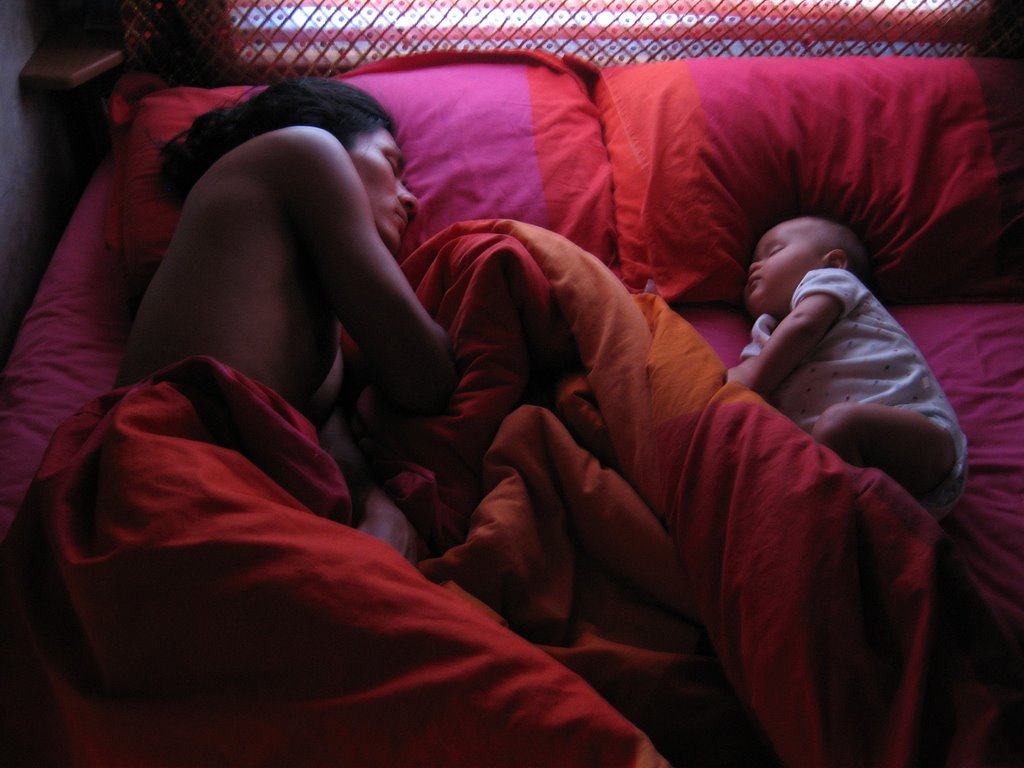
Nothing to do with the telenovela, just a picture of my two men sleeping late.
Monday, June 19, 2006
Late news on Fuji.
June 19, Woodland.
Missed news: Fuji came back on Friday and is doing great. He looks ten years younger, having lost a lot of weight, and the paralysis is not overwhelming. He walks with a cane, can now move his arm more and more, and has regained some feelings in his affected side. His wife, Eduarda Torres, is with him.
I didn't know he was here until yesterday when I walked right by him and didn't recognize him.
Missed news: Fuji came back on Friday and is doing great. He looks ten years younger, having lost a lot of weight, and the paralysis is not overwhelming. He walks with a cane, can now move his arm more and more, and has regained some feelings in his affected side. His wife, Eduarda Torres, is with him.
I didn't know he was here until yesterday when I walked right by him and didn't recognize him.
Gil.
June 19, Woodland, California.
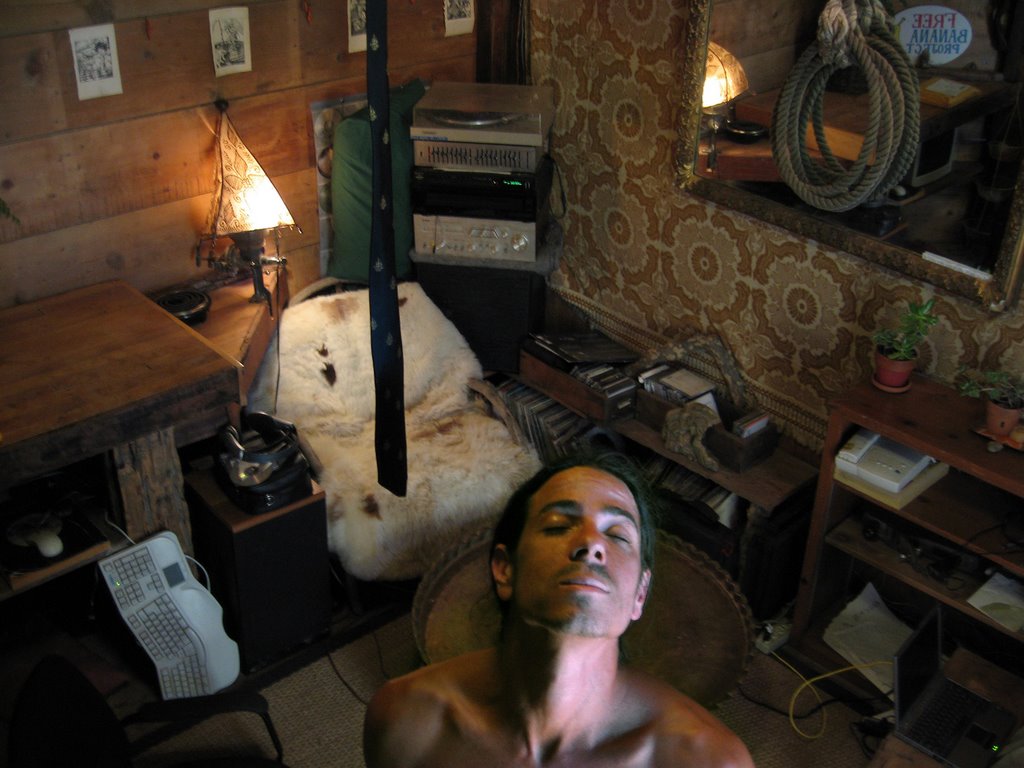
On the farm there was also Gil.
Gil is young and tanned, wears his hair very long and walks around the farm without a shirt or shoes on. He is originally from Israel, went to school at the University of California at Davis and graduated in child development. He now lives and works on the farm, and he has built his own room in the common building there out of materials from demolition and abandoned construction sites. He's found red fur, old-growth redwood, pine, maple. He talks about insulating the roof with redwood bark, cools his room with a custom-made system consisting of storing cold air from the night in the foundation space under the building and blowing it inside with a fan during the hottest hours day. It works.
Matt, Dawn's boyfriend, is an engineer. Together with Gil it turns out they made up a good deal of engineering smarts. What a day at the farm will bring.
Gil in his room.
Sunday, June 18, 2006
Neighbors.

June 18, Rancho Cordova.
Turns out I was neighbor to an oasis of a river, a 20-acre farm and a newfound friend and I didn't even know about it.
Late on Wednesday night when we pulled into the soccer field in Hagan Park, Dawn, her daughter Renna and her boyfriend, Matt, were getting ready to go to bed. Matt called out to Dawn that there was a semi tractor-trailer in the field. Whatever, said Dawn, thinking he'd probably not seen right. Shortly thereafter he called out again. There's a guy out walking and waving a flashlight, he must be drunk or something, he said.
Dawn told me the story when she came to visit us in the trailer on Friday afternoon. They'd discovered upon waking up the next morning there was a circus in their front yard, she'd gone and seen the show and looked up the website afterwards, ultimately stumbling upon the blog. Can I come visit?, she asked, we're going to be neighbors for three days.
Dawn has raised an adult son and is now raising her daughter, mostly by herself. Renna, who is thirteen, is a poised, shy girl who surprises you when she suddenly sparks to show you her artwork. Mother and daughter share a peaceful nonchalance.
Dawn was always fascinated by the circus, I with the farm. She took me to the river, the American river. It flowed just a few hundred yards behind the circus, the water wonderfully cold, straight from the Sierra snows, the currents so swift. She took me to the farm, a co-op owned and leased by the county of Sacramento. Ten people live on it, renting houses, raising chicken and sheep. The land was bought by the county some 20 years ago and is now an oasis of green amidst the infringing suburbs. She gave me a tour, introduced me around, held Dylan while I used her wireless connection. She sent me home with fresh eggs and grapefruits from the farm, fell in love with Dylan. She and Matt even took me to the farmer's market in downtown Sacramento and came to see the show a second time on Sunday.
Turns out I had a friend in Sacramento. She's living out one of my other dream life, waking up to the roosters every morning, looking out to the fields, walking to the river for a swim. Circus life: a day on the farm, thanks to my newfound neighbors.
Dawn and her daughter, Renna, 13, in front of some of Renna's paintings, in their livingroom.
Adios.
June 16, Rancho Cordova.
Marvin's turn to go.
He was the midget clown from Mexico, the second clown after Genia.This morning as we were leaving on errands we saw him talking on the phone by the office and by the time we came back a couple of hours later we learnt that he was gone from the circus, apparently over an argument with Jim. I'm not sad to see him go; his acts as bad as they come, the scratching my ass and crotch type of low-flying humor, bringing down the quality of the show quite a notch. Adios and good luck.
Marvin's turn to go.
He was the midget clown from Mexico, the second clown after Genia.This morning as we were leaving on errands we saw him talking on the phone by the office and by the time we came back a couple of hours later we learnt that he was gone from the circus, apparently over an argument with Jim. I'm not sad to see him go; his acts as bad as they come, the scratching my ass and crotch type of low-flying humor, bringing down the quality of the show quite a notch. Adios and good luck.
Thursday, June 15, 2006
The Democratic Idea.
June 15, Rancho Cordova, California.
The circus is parked in Hagan Park, in Rancho Cordova, a suburb of Sacramento.
Beautiful public park, vast expanse of shaded, well-tended lawns, oaks, pines, magnolias, ponds and paths, baseball field after baseball field, stretching as far as the eye can see. The idea that you need to set aside land for public use, as strong today in the expanding suburbs as it was in 1858 when Frederick Law Olmsted and Calvert Vaux designed that quintessential public park, Central Park, in New York City, the civic idea, the idea of the American democracy, unique in history, passionately alive despite or because of the other side of the American coin, the greed, the reign of money gone crazy, the Enrons, the widening gap between the rich and the poor.
The public park, or the embodiment of the American faith in the fundamental goodness of its democratic experiment. My own love affair with America and the American idea, the ongoing fascination, after all these years, in spite of everything, still.
The circus is parked in Hagan Park, in Rancho Cordova, a suburb of Sacramento.
Beautiful public park, vast expanse of shaded, well-tended lawns, oaks, pines, magnolias, ponds and paths, baseball field after baseball field, stretching as far as the eye can see. The idea that you need to set aside land for public use, as strong today in the expanding suburbs as it was in 1858 when Frederick Law Olmsted and Calvert Vaux designed that quintessential public park, Central Park, in New York City, the civic idea, the idea of the American democracy, unique in history, passionately alive despite or because of the other side of the American coin, the greed, the reign of money gone crazy, the Enrons, the widening gap between the rich and the poor.
The public park, or the embodiment of the American faith in the fundamental goodness of its democratic experiment. My own love affair with America and the American idea, the ongoing fascination, after all these years, in spite of everything, still.
Wednesday, June 14, 2006
Payback.
June 14, Lodi.
Dylan turns seven months today, and has turned impossible lately. The last two nights he has screamed his head off at bed time for no apparent reason, and no calming technique will work. It is as if my worst fears about screaming babies had come to bear, those old nightmares from when I didn't want to even hear the word baby; me, I'll never have kids, thanks and don't bother to ask again, and it makes me feel not only inadequate but also unworthy as he struggles and pushes me away no matter what I do.
Welcome to the club - like a faint echo.
Dylan turns seven months today, and has turned impossible lately. The last two nights he has screamed his head off at bed time for no apparent reason, and no calming technique will work. It is as if my worst fears about screaming babies had come to bear, those old nightmares from when I didn't want to even hear the word baby; me, I'll never have kids, thanks and don't bother to ask again, and it makes me feel not only inadequate but also unworthy as he struggles and pushes me away no matter what I do.
Welcome to the club - like a faint echo.
Giants.
June 13, Lodi, California.
Went to Wal-mart to look for the last supplies needed to put the finishing touches on the custom-made crib (inauguration was last Saturday, no wood splitting, baby survived,) the "small" version, as usual in California, where the first giant so-called Wal-mart supercenter only opened a couple of years ago. I remember covering it for the Press-Enterprise; the first giant store allowed to open in the state was in La Quinta, near Palm Springs; they're still far and between. It occurred to me that there wasn't a town we worked between Brownsville, Texas, and Twentynine Palms, California, that didn't have a Wal-mart supercenter. Not one. California, with its scarcity of giant Wal-marts, feels like a foreign land.
Went to Wal-mart to look for the last supplies needed to put the finishing touches on the custom-made crib (inauguration was last Saturday, no wood splitting, baby survived,) the "small" version, as usual in California, where the first giant so-called Wal-mart supercenter only opened a couple of years ago. I remember covering it for the Press-Enterprise; the first giant store allowed to open in the state was in La Quinta, near Palm Springs; they're still far and between. It occurred to me that there wasn't a town we worked between Brownsville, Texas, and Twentynine Palms, California, that didn't have a Wal-mart supercenter. Not one. California, with its scarcity of giant Wal-marts, feels like a foreign land.
Tuesday, June 13, 2006
98 glory days.
June 11, Elk Grove.
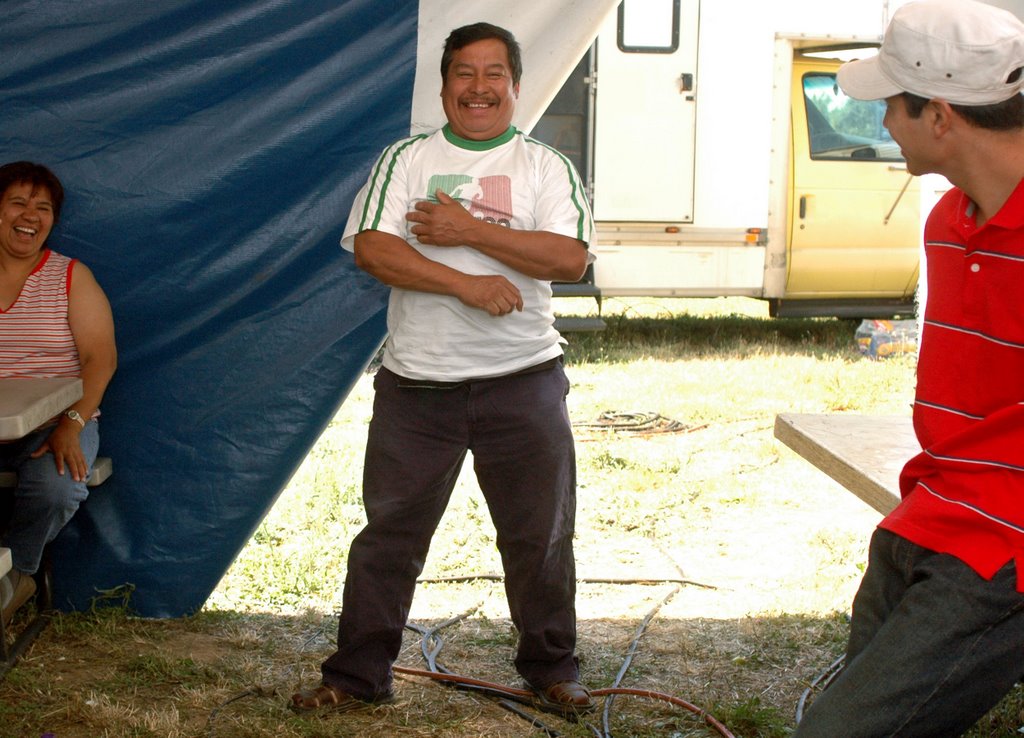
Another wake-up call full of shouts. Mexico against Iran, the shouts were for the three goals Mexico scored, to win 3 to 1. In truth I was expecting more of a showing under the cookhouse ten, only about a dozen people were there, but that was enough to raise a storm.
The emotion, the excitement reminding me of the 1998 World Cup, France's triumph at home, trois à zéro, the mounting fervor, the madness, the passion, the country united, beating with one heart, the dream come true of the final match against Brasil, the streets of Paris taken over by millions, literally, after the victory, the whole country erupting in one shout, uniting in a frenzy of joy and pride, Black Blanc Beur, forgetting its ills and disputes, together in the unexpected, overwhelming, jubilant victory. Nothing like a little sports to patch up the frayed social fabric of a country already torn apart by its immigrant challenge.
If only it had lasted for more than the time it took to play that glorious World Cup.
Alberto Sanchez Martinez, better known as Beto, shows his colors during the Mexico/Iran match.
Bang.
June 10, Elk Grove, California.
Yesterday we were awaken by a shouting assault, coming from the cookhouse behind us. La Copa del Mundo, la Coupe du Monde, the soccer World Cup 2006 had begun.
(Today tio Tito shut himself up in his trailer this afternoon to watch the Argentina/Ivory Coast match; the guys wouldn't leave him alone about it. He emerged triumphantly, wearing the Argentinian team's shirt, after the first Argentina goal.)
It was a day full of shouts, the soccer fans' (ie, everybody in the circus minus, maybe, Ekaterina) and Dylan's. He's turned impossible these past few days, testing his voice and our patience. And then we also got married, swearing the eternal love of marriage in the Sacramento county clerk's office, in an airless room under a plastic canopy with white and pink plastic flowers and two little white plastic angels on the side. After being together for more than five years we held hands before Dylan, a marriage commissioner and an anonymous witness, half mangling the vows, overcome by emotion after all.
(Argentina won.)
Yesterday we were awaken by a shouting assault, coming from the cookhouse behind us. La Copa del Mundo, la Coupe du Monde, the soccer World Cup 2006 had begun.
(Today tio Tito shut himself up in his trailer this afternoon to watch the Argentina/Ivory Coast match; the guys wouldn't leave him alone about it. He emerged triumphantly, wearing the Argentinian team's shirt, after the first Argentina goal.)
It was a day full of shouts, the soccer fans' (ie, everybody in the circus minus, maybe, Ekaterina) and Dylan's. He's turned impossible these past few days, testing his voice and our patience. And then we also got married, swearing the eternal love of marriage in the Sacramento county clerk's office, in an airless room under a plastic canopy with white and pink plastic flowers and two little white plastic angels on the side. After being together for more than five years we held hands before Dylan, a marriage commissioner and an anonymous witness, half mangling the vows, overcome by emotion after all.
(Argentina won.)
Friday, June 09, 2006
Birthdays and a little house of dolls.
June 7, Vacaville.
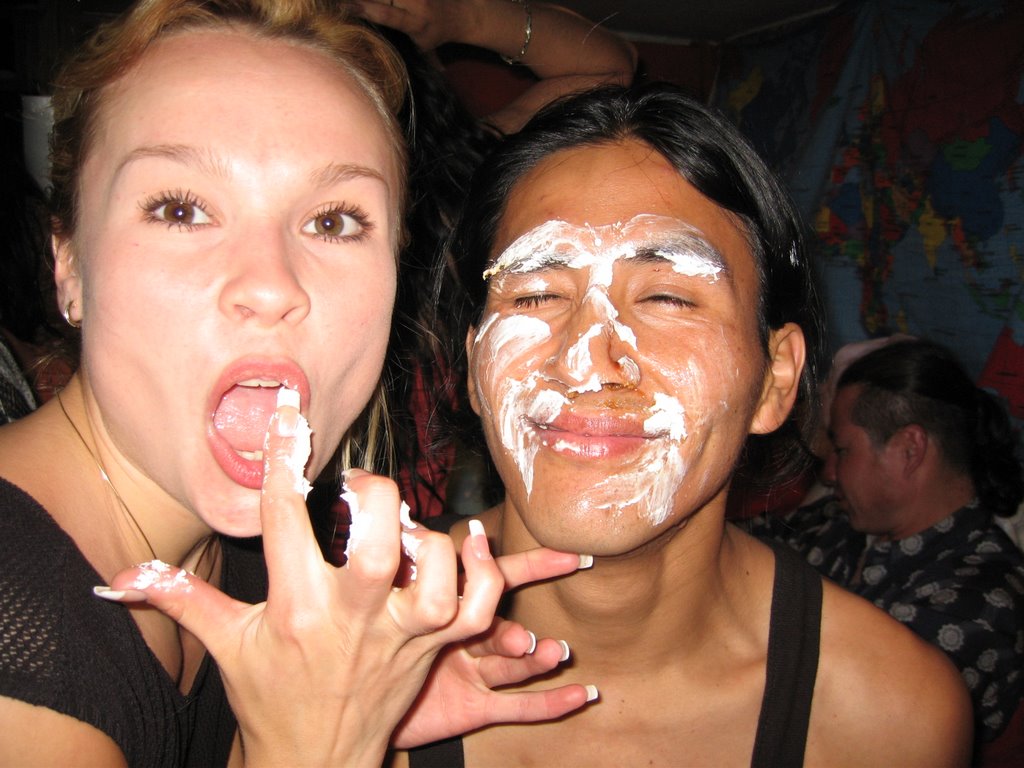
Yesterday was Fridman's birthday. I threw him a party last night, and Shirly and her family surprised us by coming all the way from San Bruno. Angelo telenovela, continued.
Fridman turned 28. He didn't want a party, didn't want to do anything, not even tell his friends in the circus about it: the obsession of youth, feeling "old" when you're still in your twenties. I don't know whether it's related, but the Spanish language's love affair with diminutives reminds me of this youth fixation. There isn't a loaf of bread that isn't a "pancito," a little bread; a car that's not a "carrito," a little car; a dog that's not a "perrito," a little dog, as if all of Latino America were a house of dolls.
Ekaterina and Fridman's cake.
Tuesday, June 06, 2006
A tooth.
June 5, Vacaville, California.
Another first: Dylan got his first tooth today, barely visible in the bulging gum but there all right.
Another first: Dylan got his first tooth today, barely visible in the bulging gum but there all right.
Monday, June 05, 2006
Circus bets.
June 4, Santa Rosa.
World Cup raffle last night at the cookhouse, organized by tío Tito. For twenty dollars one could bet on the best team, for ten on the worst. The United States team name predictably drew unanimous laughs.
World Cup raffle last night at the cookhouse, organized by tío Tito. For twenty dollars one could bet on the best team, for ten on the worst. The United States team name predictably drew unanimous laughs.
Sunday, June 04, 2006
BHL.
June 3, Santa Rosa.
In the early morning hours I steal a few moments to read.
This would be the perfect time for me to work; if I'm lucky like today the baby naps and Fridman is still asleep, everything is nice and quiet. But I can't work because I need electricity to be able to connect to the internet (I use an ethernet bridge, which plugs in,) and the circus generator is not turned on until much later, usually around 9:30 AM or so. So I indulge - I read.
In the package my Mom sent me there was a book she'd liked. It's called "American Vertigo," by Bernard-Henri Lévy. "BHL," as he is alternatively affectionately and derisively called by his countrymen, is the quintessential French intellectual: a philosopher and writer, he is self-important, sophisticated, artfully arrogant, and of TV stardom status. He is as a matter of fact married to a flamboyant actress, Arielle Dombasle, very American in her bleach blond-skinny-and-extra-wide-smile style, and they are a celebrity couples' dream team. I suppose it does say something for French society that philosophers and writers regularly attain such movie star status, for BHL is by no means the only one.
The book, which the author says was commissioned by The Atlantic magazine, is a road trip through the United States on the heels of that most famous of Frenchmen in this country after Lafayette, Alexis de Tocqueville. It is an easy read and surprisingly interesting. But the devil is in the details.
Lévy devotes two pages, for example, to the theory that the left lane on highways not being intended for faster drivers is a reflection of the equalitarian nature of the US. I guess like a majority of American drivers he let all the "Slower vehicles keep right" signs on the side of the highway go totally unnoticed. Further on he goes on for a whole sub-chapter ("Hillary and the stain") about Hillary Rodham Clinton's run for president being hard on her because she would have to face being into the very office where her husband cheated on her.
All in all more revealing of the French obsession with the sex life of their politicians than they would like to admit, in a country where a president served two seven-year terms with a daughter by one of his mistresses growing up in a posh Paris neighborhood a well-kept secret, and if I'm not mistaken, at the taxpayers' expense (the nature of the French press and its role in that affair, no pun intended - most newsmen knew of the daughter but none came out publicly about it until the president had officially okayed it, after he'd left office.)
In another oops instance, BHL talks about Lackawanna being "50 miles west of Buffalo, NY." You're left to wonder if the guy actually did make the trip or just sent someone to sweat out the traffic, and whether very intellectual editors in France know how to check a map.
I'm only a quarter into the book.
(To be continued.)
In the early morning hours I steal a few moments to read.
This would be the perfect time for me to work; if I'm lucky like today the baby naps and Fridman is still asleep, everything is nice and quiet. But I can't work because I need electricity to be able to connect to the internet (I use an ethernet bridge, which plugs in,) and the circus generator is not turned on until much later, usually around 9:30 AM or so. So I indulge - I read.
In the package my Mom sent me there was a book she'd liked. It's called "American Vertigo," by Bernard-Henri Lévy. "BHL," as he is alternatively affectionately and derisively called by his countrymen, is the quintessential French intellectual: a philosopher and writer, he is self-important, sophisticated, artfully arrogant, and of TV stardom status. He is as a matter of fact married to a flamboyant actress, Arielle Dombasle, very American in her bleach blond-skinny-and-extra-wide-smile style, and they are a celebrity couples' dream team. I suppose it does say something for French society that philosophers and writers regularly attain such movie star status, for BHL is by no means the only one.
The book, which the author says was commissioned by The Atlantic magazine, is a road trip through the United States on the heels of that most famous of Frenchmen in this country after Lafayette, Alexis de Tocqueville. It is an easy read and surprisingly interesting. But the devil is in the details.
Lévy devotes two pages, for example, to the theory that the left lane on highways not being intended for faster drivers is a reflection of the equalitarian nature of the US. I guess like a majority of American drivers he let all the "Slower vehicles keep right" signs on the side of the highway go totally unnoticed. Further on he goes on for a whole sub-chapter ("Hillary and the stain") about Hillary Rodham Clinton's run for president being hard on her because she would have to face being into the very office where her husband cheated on her.
All in all more revealing of the French obsession with the sex life of their politicians than they would like to admit, in a country where a president served two seven-year terms with a daughter by one of his mistresses growing up in a posh Paris neighborhood a well-kept secret, and if I'm not mistaken, at the taxpayers' expense (the nature of the French press and its role in that affair, no pun intended - most newsmen knew of the daughter but none came out publicly about it until the president had officially okayed it, after he'd left office.)
In another oops instance, BHL talks about Lackawanna being "50 miles west of Buffalo, NY." You're left to wonder if the guy actually did make the trip or just sent someone to sweat out the traffic, and whether very intellectual editors in France know how to check a map.
I'm only a quarter into the book.
(To be continued.)
Saturday, June 03, 2006
Jim's prayer.
June 2, Santa Rosa, California.
Fuji is out of intensive care; he's now at a rehabilitation center in Santa Cruz. Jim came back to the circus last night.
"He is improving every day," he said. Fuji still has no use of nor feelings in half his body, with all the implications this has. "How do you tie your shoes with only one hand?" asked Jim. "His face is dropping on one side and when people see him at the circus he's going to look sad, but on his first day at the hospital we didn't know if he was going to live, so there's a lot of improvement," he added.
Jim found a card on the ground in the parking lot of the hospital on that first day. It was the Lord's Prayer in Spanish. There was no garbage on the lot, not even a piece of paper anywhere to be seen. "There was absolutely nothing around, but there was this card," Jim said. "On those first days I clung to that. It was a sign that he was going to be all right," Jim said, smiling, as he showed me the card.
Where it not for the merciful goodwill of the hospital there would be some one hundred thousand dollars worth of bills to pay. A day in rehab alone runs into the three thousand dollar range. "They were really good; they worked with us so that it would not be that much," said Jim. Yet one more reminder of the painfully obvious fact that this country is desperately in need of a health care system worthy of the name, one that includes everybody and is affordable for the common man, not to mention for society as a whole.
You can't afford health care but you're surrounded with cheap stuff. In unrelated news we the lucky few, the rich Westerners, live in a society where it actually costs more to buy something in a store than make it yourself.
We went to buy supplies to make a mattress for the custom-made crib Fridman has built for Dylan and found out it would cost about a third more to do so than to buy a mattress at the local chain store. Simple economic supply and demand logic, yet there is something unsettling about the idea.
Fuji is out of intensive care; he's now at a rehabilitation center in Santa Cruz. Jim came back to the circus last night.
"He is improving every day," he said. Fuji still has no use of nor feelings in half his body, with all the implications this has. "How do you tie your shoes with only one hand?" asked Jim. "His face is dropping on one side and when people see him at the circus he's going to look sad, but on his first day at the hospital we didn't know if he was going to live, so there's a lot of improvement," he added.
Jim found a card on the ground in the parking lot of the hospital on that first day. It was the Lord's Prayer in Spanish. There was no garbage on the lot, not even a piece of paper anywhere to be seen. "There was absolutely nothing around, but there was this card," Jim said. "On those first days I clung to that. It was a sign that he was going to be all right," Jim said, smiling, as he showed me the card.
Where it not for the merciful goodwill of the hospital there would be some one hundred thousand dollars worth of bills to pay. A day in rehab alone runs into the three thousand dollar range. "They were really good; they worked with us so that it would not be that much," said Jim. Yet one more reminder of the painfully obvious fact that this country is desperately in need of a health care system worthy of the name, one that includes everybody and is affordable for the common man, not to mention for society as a whole.
You can't afford health care but you're surrounded with cheap stuff. In unrelated news we the lucky few, the rich Westerners, live in a society where it actually costs more to buy something in a store than make it yourself.
We went to buy supplies to make a mattress for the custom-made crib Fridman has built for Dylan and found out it would cost about a third more to do so than to buy a mattress at the local chain store. Simple economic supply and demand logic, yet there is something unsettling about the idea.
Blind faith.
June 1, Petaluma.
I got a package my mother sent me from France care of the United States Post Office general delivery last week. For anybody in this country, nothing to write home about, but for circus people getting mail - and getting it on time - is rather like Christmas.
Mail is somewhat of an erratic luxury in the circus, and general delivery for mail coming from overseas is an uncertain gamble at best. Given that the time it takes for mail to come from overseas varies greatly (I like to imagine it must depend on whether it catches an early flight, like a businessman,) you then have to aim it so that it's not at the post office for more than ten days before you go pick it up, or it will be sent back, but at the same time it has to be there in time for you to pick it up, too, and the window of opportunity is usually three days, six at most.
The game involves a little bit of luck, a good deal of planning, and a pinch of blind faith.
I got a package my mother sent me from France care of the United States Post Office general delivery last week. For anybody in this country, nothing to write home about, but for circus people getting mail - and getting it on time - is rather like Christmas.
Mail is somewhat of an erratic luxury in the circus, and general delivery for mail coming from overseas is an uncertain gamble at best. Given that the time it takes for mail to come from overseas varies greatly (I like to imagine it must depend on whether it catches an early flight, like a businessman,) you then have to aim it so that it's not at the post office for more than ten days before you go pick it up, or it will be sent back, but at the same time it has to be there in time for you to pick it up, too, and the window of opportunity is usually three days, six at most.
The game involves a little bit of luck, a good deal of planning, and a pinch of blind faith.
First times story.
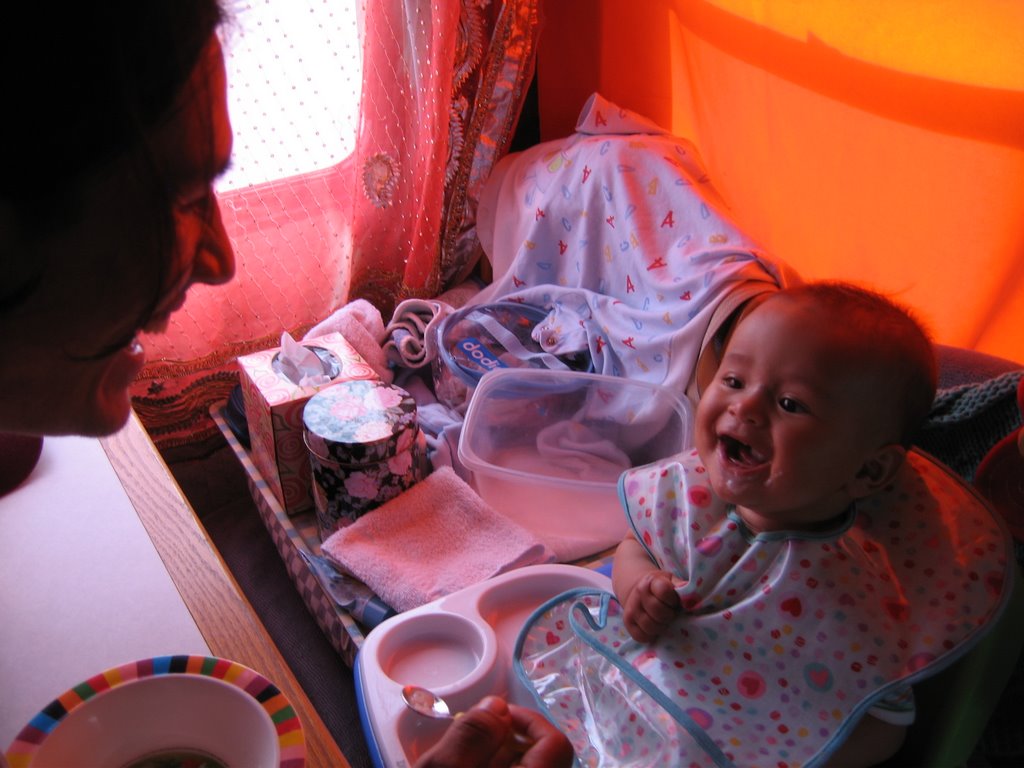
May 31, Petaluma, California.
First time in the booster seat for Dylan (no space for high chairs in a trailer,) and even though he doesn't sit unassisted yet he was just grand. Ah, the time of first times - always going back to the founding principle: carpe diem through life with a passion.
He's started taking solid foods more easily, a month after I slowly introduced them. I prepare everything at home and bow to the steamer and food processor gods. Like the cloth diapers (see The Diaper Dilemna,) home-prepared food was not even pondered; it was always a given Dylan would sharpen his taste buds on home-cooked meals from the very first one, made with organic or locally grown produce whenever possible. Gerber doesn't need my money, and my baby does deserve the best I can give him.
One more thing on the To-Do daily list: bon appétit.
Subscribe to:
Posts (Atom)
